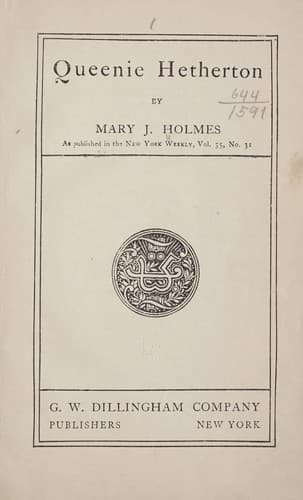
American fiction -- 19th century; Dime novels; Man-woman relationships -- Fiction; Upper class -- Fiction
This time it was Mrs. Rossiter and her daughters, and into Margery’s
mind there flashed the thought, “Are all the Fergusons coming here
to-day, and what would they say if they knew who my mother was?” But
they did not know or dream of the exciting interview in the room above,
where Reinette questioned so rapidly and impatiently the woman who
almost crouched at her feet in her abasement and answered amid tears and
sobs. The Rossiters had merely come to ask when Miss La Rue could do
some work for them, and they left very soon taking grandma with them, to
the great relief of Margery, who locked the door upon them, determined
that no one else should enter until Reinette was gone and she knew
herself why the truth had been withheld from her.
Up stairs the talk was still going on, though the voices now were low
and quiet as if the storm was over: but would the interview never end?
would Reinette never leave her free to go to her mother herself and
demand an explanation? Slowly, as it seemed, the hour hands crept on
until it was twelve o’clock, and then at last a door opened and shut,
and Queenie came down the stairs, her eyes red with weeping, but with a
look of content upon her face which surprised Margery a little.
“She cannot be very angry with mother,” she thought and her heart began
to grow lighter as Queenie came up to her, and putting her arms around
her neck, said to her:
“Margie, it makes you seem nearer to me, now that I know your mother was
my nurse, and I love you more than ever. But how white you are, and your
hands are like lumps of ice. Are you sick?” she continued, as she looked
with alarm at Margery’s face, which was as white as ashes.
“Not sick, but a good deal upset with what I have heard,” Margery
replied; “but tell me,” she continued, “what does mother say? Why has
she never told you who she was?”
“She says it was for your sake; that she feared lest I might think less
of you if I knew you were the daughter of my former nurse,” Queenie
replied, and looking earnestly at her, Margery asked:
“And you believe this to be the only reason, don’t you?”
“No, I do not,” Queenie answered, promptly. “It is true in part, no
doubt, but there is something she did not tell me, and which I am
resolved to find out. But I did not tell her so, she seemed so scared—so
like a frightened child. Margery, I believe your mother is more than
half crazy.”
“Yes, yes,” and Margery caught eagerly at the suggestion. “You are
right; she is crazy. I can see it now, and that will account for much
which seems so strange. Oh, Queenie, be patient; be merciful. Remember,
she is my mother.”
Public-domain text, read in full here on John Shaqi.
Reviews
Reviews
No reviews yet
Be the first to share your thoughts on this work.
Elsewhere in the archive
Join the Discussion
Join the discussion
Sign in to leave a comment or review.
Sign InorCreate an account