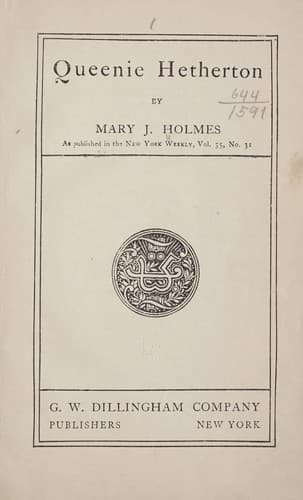
American fiction -- 19th century; Dime novels; Man-woman relationships -- Fiction; Upper class -- Fiction
“Dr. Nichols here? Mrs. La Rue must be worse. I am glad I came,”
Reinette thought, as she went rapidly up the walk and entered
unannounced.
“How is Mrs. La Rue, and where is Margery?” she asked of a woman whom
she met in the hall, and whom she recognized as a neighbor.
“Don’t you know? Haven’t you heard? Margery has had an apoplectic fit,
and is dying,” was the woman’s reply, and with a shriek of terror and
surprise Reinette fled past her up the stairs to Margery’s room, where
she paused a moment on the threshold to take in the scene which met her
astonished view.
By the window, which was raised to admit the air, the doctor stood, with
a grave, troubled look, while near him sat Mrs. La Rue, with a face
which might have been cut from stone, so rigid and immovable was every
feature, while her eyes, deep-set in her head, with dark circles around
them, seemed like coals of fire as they turned upon Reinette, who
shuddered with fear at their awful expression. At sight of her the
woman’s lips moved, but made no sound—only her fingers pointed to the
bed where Margery lay breathing heavily, but with no other sign to show
that she was living. She looked like one dying, and had looked thus
since the moment she fell to the floor at the end of her mother’s story.
For a few moments Mrs. La Rue had been as helpless and almost as
insensible as her daughter; then, rousing herself with a great effort,
she knelt beside the unconscious girl, and lifting her head covered the
white face with kisses and tears, and called upon her by every tender
epithet to open her eyes and speak, if only to curse the one who had
wrought so much harm. But Margery’s ears were deaf alike to words of
love or pleading, and she lay so still, and looked so awful, with that
bloody froth about her lips, that, at last, in wild affright, her mother
called for help, and the woman who lived next door was startled by a
succession of cries, each louder than the preceding, and which came
apparently from Mrs. La Rue’s cottage. Entering at a rear door, and
following the direction of the sounds, she came to the chamber where
Margery still lay upon the floor, with her mother bending over her and
shrieking for aid. To lift Margery up and carry her to bed, and send for
a physician, was the woman’s first work, and then she tried what she
could do to restore the insensible girl, who only moaned faintly in
token that she knew what was passing around her. When questioned by the
physician, who was greatly puzzled by the case, Mrs. La Rue said that
Margery had not seemed well for some time—had overworked, she thought,
and that she had fallen suddenly from her chair while talking to her
after dinner. This was all the explanation she would give, and, more
perplexed than he had ever been in his life, the physician bent his
energies to help the young girl who, it seemed, even to him, was dying,
for the most powerful restoratives and stimulants failed to produce any
effect, or to move so much as an eyelid.
Public-domain text, read in full here on John Shaqi.
Reviews
Reviews
No reviews yet
Be the first to share your thoughts on this work.
Elsewhere in the archive
Join the Discussion
Join the discussion
Sign in to leave a comment or review.
Sign InorCreate an account