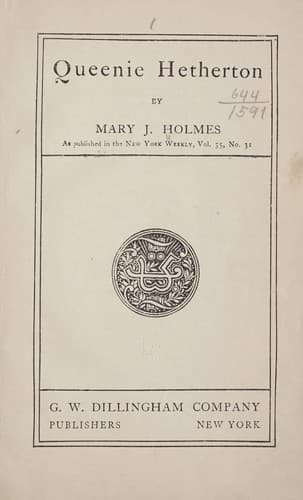
American fiction -- 19th century; Dime novels; Man-woman relationships -- Fiction; Upper class -- Fiction
“Can it be possible that Margery takes it so to heart, and does she fear
that it will make any difference in my love for her? It shall not, and I
will prove it to her.”
After this Queenie took up her abode, for the time being, at the
cottage, of which she was really the head, for Mrs. La Rue did nothing
but sit by Margery and watch her with a pertinacity and earnestness
which annoyed the sick girl, when she came to realize what was passing
around her, and made her try to escape the steady gaze of those strange
eyes always watching her.
“Do not look at me,” she said at last one day. “Move back, please, where
I cannot see you.”
Without a word Mrs. La Rue moved back into the shadow, but did not leave
the room, except at intervals to eat and sleep, and thus the whole
charge of the cottage fell upon Reinette, who developed a wonderful
talent for housekeeping, and saw to everything. Much of her time,
however, was passed with Margery, on whom she lavished so much love that
her caresses seemed at times to worry the sick girl, who would moan a
little and shrink away from her.
“What is it, Margie, darling? Do I tire you?” Reinette asked her, one
day, when they were alone for a few moments, and Margery had seemed
uneasy and restless.
For a moment Margery did not answer, but lay with her eyes shut while
the great tears rolled down her cheeks; then, suddenly raising herself
in bed, she threw her arms around Reinette’s neck and sobbed:
“Oh, Queenie, Queenie, you do not know, I cannot tell you how much I
love you, more than I ever did before, and yet I am so sorry; but you
will love me always, whatever happens, won’t you?”
“Why, yes, Margery. What can happen, and why shouldn’t I love you?”
Queenie asked, as she held the beautiful golden head against her bosom,
and kissed the quivering lips. “Margery,” she continued, “do you feel so
badly because of your mother’s silence! She has explained it to me, and
I am satisfied. Don’t let that trouble you anymore. No others beside
ourselves need know who she is, and thus all talk and comment will be
spared.”
“I know, I know,” Margery replied, “but, Queenie, you told me you
believed there was something else-some other reason, and you meant to
write to France; do you mean it still? Will you try to find it out?”
“Yes, I think so,” Queenie answered, “just for my own curiosity. I shall
make no bad use of it. I shall not harm you.”
“No, no; you must not seek to know,” Margery exclaimed, with energy.
“There _was_ something, Queenie. I have wrung it from her. She did right
to keep silent. She ought not to have spoken. And Queenie, if you love
me, promise me you will never try to find it out—never write to anyone
in France. Promise, or I shall certainly die.”
She had disengaged herself from Queenie’s embrace, but was sitting
upright in bed, with a look upon her face like one who is really losing
her senses. It startled Reinette, who answered unhesitatingly:
Public-domain text, read in full here on John Shaqi.
Reviews
Reviews
No reviews yet
Be the first to share your thoughts on this work.
Elsewhere in the archive
Join the Discussion
Join the discussion
Sign in to leave a comment or review.
Sign InorCreate an account