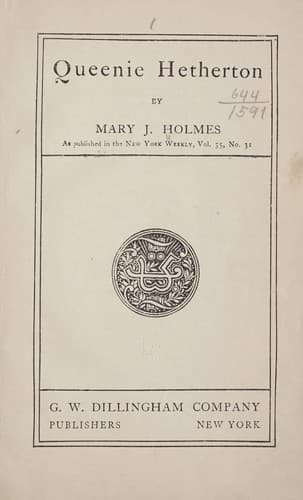
American fiction -- 19th century; Dime novels; Man-woman relationships -- Fiction; Upper class -- Fiction
“She will be so quiet there, with nothing to excite her, and I shall
take care of her all alone. You, I suppose, will have to stay here and
see to the cottage,” she said to Mrs. La Rue, who assented in silence,
for she knew that her presence was a constant source of pain and
excitement to Margery, who undoubtedly would improve more rapidly away
from her.
But she doubted if Hetherton Place was the spot to take her, and Margery
doubted, too, but Queenie carried her point, and bore her off in
triumph, leaving Mrs. La Rue alone in the cottage to combat her remorse
and misery as best she could. Everything which love could devise or
money do was done to make Margery happy at Hetherton Place. The
sitting-room and sleeping-room across the hall from Reinette’s, which
were to have been Mr. Hetherton’s, were given to her, and all the rarest
flowers in the greenhouse were brought to beautify them. And there the
two girls took their meals, and sat and talked, or rather Queenie
talked, while Margery listened, with her hands folded listlessly
together, and her eyes oftentimes shut, while around her mouth there was
a firm, set expression, as if she were constantly fighting something
back, rather than listening to Reinette, who chatted gayly on, telling
how delightful it seemed to have Margery there, and how she wished she
could keep her always.
“You ought to have just such a home as this. It suits you better than
the cottage, where it is work, work all the time, for people who are
some of them small enough to think you beneath them because you earn
your own living,” she said, one afternoon when they sat in the gathering
darkness, with no light in the room, save that which came from the fire
in the grate. “Yes,” Reinette continued, “I do believe you would make a
fitter mistress of Hetherton Place than I do. You are always so quiet,
and dignified, and lady-like, while I am hot and impulsive, and do and
say things which shock my high-bred cousins, Ethel and Grace.”
Margery did not reply, but she was glad her companion could not see the
pallor which by the faint, sick feeling at her heart, she knew was
spreading over her face. Just then lights were brought in by Pierre, and
in a moment the supper which the girls took together at that hour
appeared, and was arranged upon a little round table, which was drawn
near to Margery’s easy-chair.
“This is so nice,” Queenie said, “and carries me back to Chateau des
Fleurs, when we were little girls, and used to play at make believe. Do
you remember it, Margie?”
“Yes, yes; I remember; I have forgotten nothing connected with you,”
Margery replied, and Queenie went on:
“I made believe so much that you were I, and I was you, that I used at
times to feel as if it were real, and that my rightful home was up in
Number Forty, in the Rue St. Honore. And once I dreamed that I was
actually there, alone with the cat, and had to sweep the floor and wash
the dishes as you used to do.”
“And how did you like it?” Margery asked.
Public-domain text, read in full here on John Shaqi.
Reviews
Reviews
No reviews yet
Be the first to share your thoughts on this work.
Elsewhere in the archive
Join the Discussion
Join the discussion
Sign in to leave a comment or review.
Sign InorCreate an account