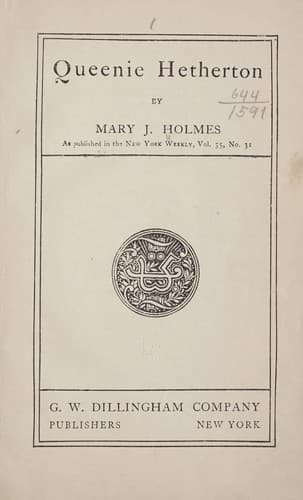
American fiction -- 19th century; Dime novels; Man-woman relationships -- Fiction; Upper class -- Fiction
“Yes; to-morrow, or next day sure. I have left you too long already.”
“And are you going to stay—always—just the same?” was Mrs. La Rue’s next
question, to which Margery replied:
“Yes; stay with you just the same, and try to make you happy.”
They were alone in Margery’s room when this conversation took place, and
when Margery said what she did, Mrs. La Rue sank down on the floor at
her feet, and clasping her knees, cried, piteously:
“Oh, Margie! my child, my child! God will bless you for what you are
doing. Oh, if I could undo it all, I would suffer torture for years and
years. My noble Margie, there are few in the world like you.”
And she spoke truly; for there have been few like Margery La Rue, who,
knowing what she knew, could, for the love of one little dark-eyed girl,
keep silence, and, resolutely turning her back upon all the luxury and
ease of Hetherton Place, return to her far less pretentious home and
take up the burden of life again—take up the piles of work awaiting her,
for her patrons knew her worth, and would go nowhere else as long as
there was a prospect of her ultimate recovery. Even Anna Ferguson had
kept her work for Margery, and had postponed her wedding that her bridal
dress might be made by the skillful fingers of the French girl, who at
last fixed the day for her return to her own home.
Reinette would fain have kept her longer, but Margery was firm in her
determination. She had been at Hetherton Place nearly three weeks, and
had grown so accustomed to the ease, and luxury, and elegance about her
that the life seemed to belong to her, and was far more to her taste
than the hard work at the cottage—the _stitch_, _stitch_, _stitch_, from
morning till night for people, who looked down upon her even while they
acknowledged her great superiority to the persons of her class. It was
hard to leave it all, hard to leave Queenie and——this she confessed to
herself secretly—hard to lose the opportunity of seeing Mr. Beresford,
who had been at the house so often, and in whom she knew she was
beginning to feel a deep interest.
He spent his last evening with them, and, at Queenie’s earnest
solicitation, Margery played and sang for him, while he listened amazed
as the clear tones of her rich, musical voice floated through the rooms,
and her white hands fingered the keys as deftly and skillfully as
Queenie’s could have done.
That Margery could sing and play was a revelation to Mr. Beresford, who
stood by her side, and turned the leaves for her.
“You have given me a great pleasure,” he said, when she at last left the
piano and resumed her seat by the fire. “This is a surprise to me. I did
not suppose——”
He did not finish the sentence, but stopped awkwardly, while Margery,
who understood his meaning perfectly, finished it for him.
Public-domain text, read in full here on John Shaqi.
Reviews
Reviews
No reviews yet
Be the first to share your thoughts on this work.
Elsewhere in the archive
Join the Discussion
Join the discussion
Sign in to leave a comment or review.
Sign InorCreate an account