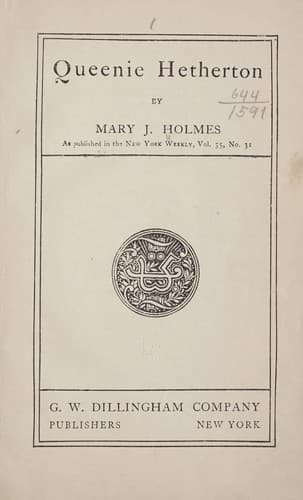
American fiction -- 19th century; Dime novels; Man-woman relationships -- Fiction; Upper class -- Fiction
It was the dawning of a new life for Margery, this feeling, that Mr.
Beresford, the proudest man in Merrivale, found delight in her society
and loved to linger at her side. It made everything else so easy, and
her life was not one of perfect rest, for Queenie did not improve as the
days went on, and to soothe, and quiet, and minister to her was not an
easy matter. She could _not_ sleep, and the physician who attended her
was beginning to fear for her reason, when she one day said to Margery,
“Where is your mother? Why has she never been to see me? Doesn’t she
care for me any more?”
“She cares very much,” Margery replied, “and she has been here several
times to ask for you, but as you would not see your cousins or
grandmother, she did not suppose you would see her. Will you see my
mother?”
“Yes, send for her,” was Queenie’s answer, and Pierre was dispatched to
Mrs. La Rue, with the message that Miss Hetherton was anxious to see
her.
And so Mrs. La Rue went to Hetherton Place, and up to the room where
Queenie sat in her easy-chair, with her face so pale and pinched, and
her eyes so large and bright, that the impulsive Frenchwoman uttered a
cry of alarm, and going to her, threw her arms around her, and cried,
“Oh, Queenie, my child, that I should find you so changed.”
“Yes, Christine,” Queenie replied, freeing herself from the stifling
embrace, “I suppose I am changed. I feel it myself, and believe I shall
die if I do not sleep. I have not slept a good sleep since I heard Phil
was dead, and I have sent for you to hold me in your arms, just as you
must have done when I was a baby, after mother died. Sing me the old
lullabies you used to sing me then, and maybe I shall sleep. I feel as
if I should—there is such a heaviness about my lids and pressure on my
brain. Take me, Christine. Play I am a baby again. I can’t be very heavy
now,” and she smiled a faint, shadowy smile, as she put up her arms to
the woman who took her up so gladly and covered the wan face with kisses
and tears, while she murmured words of pity and endearment.
“There, that will do—it wearies me,” Queenie said, and she laid her
tired head upon Christine’s shoulder and closed her heavy eyelids. “Rock
me to sleep, Christine, as you did at _Chateau des Fleurs_,” she
whispered, faintly, and, sitting down in the chair, Christine rocked the
poor little girl, and sang to her, in a low, sad voice, a lullaby of
France, such as she used to sing when, as now, the dark curly head was
pillowed on her breast.
Attracted by the sound, Margery stole softly to the door and looked in,
but Christine motioned her away and went on with her song of “Mother
Mary, guard my child,” until nature, which had resisted every exertion
and every drug, however powerful, gradually began to yield—the head
pressed more heavily, the rigid nerves softened, a slight moisture
showed itself under the hair upon the forehead, and the eyes, which had
been so wild and bright, were closed in slumber.
Public-domain text, read in full here on John Shaqi.
Reviews
Reviews
No reviews yet
Be the first to share your thoughts on this work.
Elsewhere in the archive
Join the Discussion
Join the discussion
Sign in to leave a comment or review.
Sign InorCreate an account