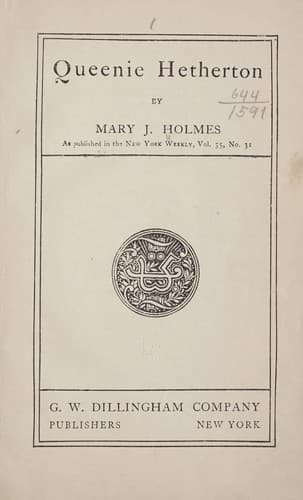
American fiction -- 19th century; Dime novels; Man-woman relationships -- Fiction; Upper class -- Fiction
“I cannot lie here,” she said, and putting on her dressing-gown she drew
her chair to the grate where the fire which Pierre had replenished just
before she retired was burning, and with her face buried in her hands,
began to think such thoughts as made the drops of perspiration stand
thickly upon her forehead and about her lips.
“Who was the Tina who wrote to my father?” she asked herself.
Not Christine; that would be too horrible. Christine had been her
mother’s maid, and it was not like a proud man like Frederick Hetherton
to think of such as she. There were other Tinas in the world. The writer
of the letter was some bright-eyed, bright-faced girl of humble origin,
who had caught her father’s fancy for a few days and been flattered by a
kind word from him, and possibly, he was for the moment more interested
in her than he ought to have been. That was all; and she was foolish to
be so disquieted.
Thus Queenie reasoned, or tried to, but all the time a terrible fear was
tugging at her heart, and she was living over again that dreadful death
scene on the ship when her father made her swear to forgive him whatever
might come to her knowledge. She had thought at first that he meant her
American relations, of whom he had never told her, and she had forgiven
that long ago. Then came the mystery concerning Christine and her
concealment of her identity, but Reinette had recovered from that and
still there was a nameless terror at her heart, as she sat alone in her
room while the clock struck the hours two and three, and the fire in the
grate grew lower, and the winter night seemed to grow thicker and colder
around her.
At last, when she could keep still no longer, she arose, and pacing the
room hurriedly, beat the air with her hands, as she was wont to do under
great excitement.
“What is it I fear?” she asked herself. “What is it I suspect? Let me
put it into words, and see if it sounds so very dreadful. I suspect that
Christine Bodine, in her girlhood—when, I dare say, she was rather
pretty and piquant, after mother died made herself very necessary to my
father and attracted him more than she ought to have done. Such people
are very ambitious, and susceptible, too; and if my father was at all
familiar in his manner toward her, she probably was flattered at once,
and maybe cheated herself, into the belief that he would marry her, when
such an idea never existed in his brain. She probably wrote to him, and
he answered and at last made her see how mistaken she was in supposing
he could ever think of her after having known my mother. And then, by
way of amends, he settled that money upon her. Yes, that is probably the
fact of the case,” she continued, and the tightness around her heart
gave way. She could breathe more freely, and her hands ceased to beat
the air, until like lightning there flashed into her mind:
Public-domain text, read in full here on John Shaqi.
Reviews
Reviews
No reviews yet
Be the first to share your thoughts on this work.
Elsewhere in the archive
Join the Discussion
Join the discussion
Sign in to leave a comment or review.
Sign InorCreate an account