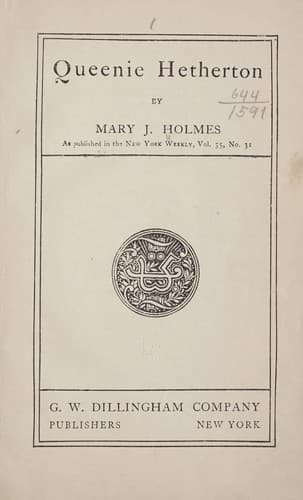
American fiction -- 19th century; Dime novels; Man-woman relationships -- Fiction; Upper class -- Fiction
“You will not believe me if I tell you that when I heard this my first
impulse was to fall at his feet and tell him of the little girl in
Paris, thoughts of whom had haunted me continually, making me sometimes
cry out with pain and remorse. But I had gone too far to confess. He
would never have forgiven me, and all my ambitious dreams for my own
child would have come to naught. I had no hope for myself; his imperious
manner and cold, disdainful words crushed all that; but there arose in
me an intense desire to see _you_ a lady, and I begged him to take you,
whatever he might do with me, and he consented at last, but bade me stay
where I was until I heard from him again. He wished to make some change
in his household, he said, for if he took you home it would be as the
child of his dead wife. I was only the nurse, who might or might not be
retained; it would depend upon myself.
“Then he left me, and I knew I was no more to him than a cast-off
garment, of which he was tired, and that in whatever arrangements he
might make, no thought for me or my comfort would actuate him; and in my
anguish I felt that my punishment was greater than I could bear, and I
even thought to kill myself and you too. But a thought of little Margery
prevented me. Somebody must care for her, and so I lived on and waited
and hoped the time might come when I could restore her to her rights.
“On quitting Marseilles your father went to Chateau des Fleurs, and, on
one pretext or another, dismissed all the servants in his employ,
filling their places with strangers, who knew nothing of his past life,
and who readily believed him when he told them of his wife who had died
in Rome, and of his little daughter whom he was soon to bring home. A
huge nursery, which communicated with his apartments, was fitted up with
every possible luxury. And then he bade me come; and I took you to him
as his lawful child, while I was only the head nurse—for he hired
another woman to look after you, giving me the post of looking after
her.
“I remember so well the day I took you to the Chateau and waited for his
coming, but waited in vain, for though he knew I was in the house, he
kept aloof from me and took his dinner, and read his paper, and smoked
his cigar, and then at last he sauntered into the nursery with that air
of elegant indifference and superiority so natural to him. I had not
seen him since his visit to Marseilles, when you were a few weeks old;
but he simply bade me good-evening, and asked if I had found everything
in readiness. Then he walked up to the cradle, and when you raised your
little hands toward him as if asking him to take you, he lifted you in
his arms, kissed your lips, and laying your head upon his shoulder said:
‘My daughter, my heiress, Reinette Hetherton.’
Public-domain text, read in full here on John Shaqi.
Reviews
Reviews
No reviews yet
Be the first to share your thoughts on this work.
Elsewhere in the archive
Join the Discussion
Join the discussion
Sign in to leave a comment or review.
Sign InorCreate an account