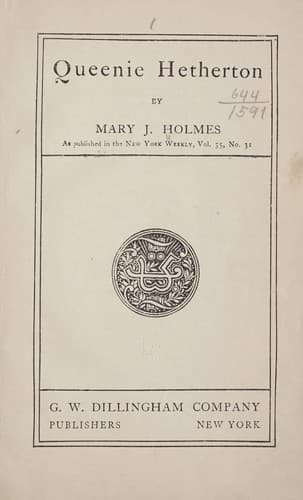
American fiction -- 19th century; Dime novels; Man-woman relationships -- Fiction; Upper class -- Fiction
And disappointed in their desire to see Reinette, the curious and
meddlesome ones turned their attention to Mrs. La Rue, but she, too,
avoided and baffled them; she had returned to the cottage in town, where
she remained perfectly quiet, seeing no one and talking with no one
except Margery and Mr. Beresford, to the latter of whom, as a lawyer,
she was always communicative, giving him any information he wished for,
and aiding him materially in procuring the proof, which, though he
deemed it superfluous, he was desirous to obtain. To others she had said
all she ever meant to say, and on the subject of her past life, her lips
were sealed forever. Silent, cold, and impassive, she moved about her
house, with no look of human interest on her white, stony face, except
when Margery came, as she did every day, with news of Queenie. Then the
pale cheek would flush for a moment and the heavy eyes light up with
eager expectancy as she asked the same question. “Has she mentioned me
yet?”
“No, not yet,” was always Margery’s answer, and then the color would
fade away and the lips shut tightly together as if in pain, but no word
of protest ever passed them, or complaint that she was not justly dealt
with by the girl whose life she had blighted.
It was Grandma Ferguson who stayed constantly with Queenie during the
first few days after the story was known, and it was wonderful to see
the love and confidence between them. With Queenie the feeling was
almost idolatrous which she felt for the woman whose coarse speech and
common ways had once been so obnoxious to her, but to whom she now clung
with more than a child’s fondness for its mother. On her bended knees,
with her head in grandma’s lap, she had confessed all the past, even to
her rebellious feelings on that day when she stood on the platform at
the station and was claimed by relatives of whom she had never heard.
“I was so wicked and proud,” she said, “for I thought myself equal to
the greatest lady in Europe, and I hated the way you spoke to me—hated
everything about you and went on hating it, especially the purple gloves
and moire antique, which made my elbows jerk, they so offended my eye.”
And grandma forgave the beautiful little sinner, and stroked the glossy,
black hair, and told her not to mind, but get up and wipe her tears
away, and be comforted.
“I ain’t an atom like you,” she said, “and never could be if I tried
ever so hard. ’Taint the purple gloves, neither, nor the _mory antique_,
which makes the difference: it is my whole make-up from the beginnin’.
Some vessels is coarse, and some is fine. Some is jugs, and some is
china, and I am a jug of the roughest kind, but I love you, Queenie, and
will stick to you through thick and thin.”
Then they talked together of Queenie’s future, and where she would go
when she left Merrivale, as she was resolved upon doing, for a time at
least.
Public-domain text, read in full here on John Shaqi.
Reviews
Reviews
No reviews yet
Be the first to share your thoughts on this work.
Elsewhere in the archive
Join the Discussion
Join the discussion
Sign in to leave a comment or review.
Sign InorCreate an account