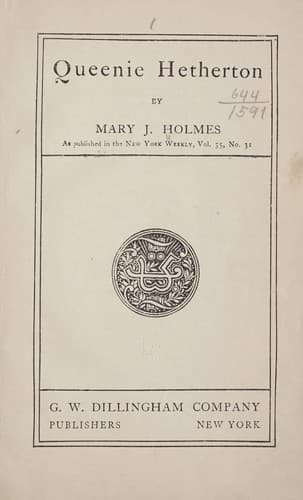
American fiction -- 19th century; Dime novels; Man-woman relationships -- Fiction; Upper class -- Fiction
This was Axie’s explanation, which was wholly satisfactory, and as it
was repeated with sundry additions, all in Queenie’s favor, she was
indorsed at once, and had she chosen, she might have been a belle and
headed every clique in the house. But Queenie was far too sad and her
heart was too full of pain to care for flattery, and yet in a way she
was interested and amused with what she saw of life at the St. James,
and liked to sit alone by herself in a quiet corner of the great parlor
and watch the people around her—the devotees of whist, who night after
night sat at the same table, with the same people, and usually with the
same result; the dancers, who occasionally varied the monotony with a
quadrille or a waltz; and the knots of lookers-on gathered here and
there in groups, and whispering their confidences to each other. It was
all very new and very strange to Queenie, who had never seen anything
like it, and she was beginning to forget in part her great sorrow in the
scenes around her, when an unexpected arrival brought the past back to
her in all its bitterness, and made her shrink more than ever from
intercourse with strangers. This arrival was none other than that of
Mistress Anna Rossiter, _nee_ Anna Ferguson, who had been three weeks a
bride, and after _doing_ Washington, as she expressed it, had resolved
to see a little of Florida life before the season was fairly over and
the Northerners gone home.
Miss Anna’s wedding had been a very quiet one, owing to poor Phil’s
recent death, and only a few of the villagers had been honored with an
invitation; but those so honored had been among the first in town—the
Grangers, and Markhams, and Marshalls, against whom Anna had once
rebelled so hotly because of fancied slights and indignities. It was now
her turn to hold up her head, she thought: she was to be Mrs. Lord
Seymour Rossiter, with a house in New York, and another on the Hudson if
she liked. She was to have a maid, and diamonds, and her carriage, and
servants in livery, for she liked those long coats and yellow boots, she
said, and she meant to have her women servants wear caps, as she was
told they did abroad.
Anna was very happy. The old days of dressmaking and drudgery were over.
No more pricked red fingers for her, no more bundles to be carried home
to those who bade her ring at the side instead of the front door.
Public-domain text, read in full here on John Shaqi.
Reviews
Reviews
No reviews yet
Be the first to share your thoughts on this work.
Elsewhere in the archive
Join the Discussion
Join the discussion
Sign in to leave a comment or review.
Sign InorCreate an account