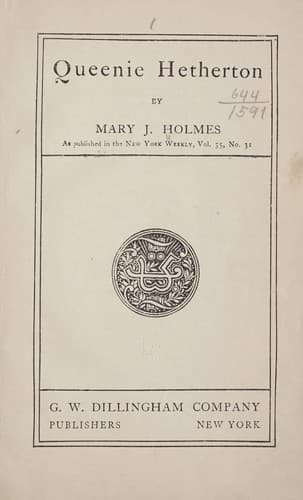
American fiction -- 19th century; Dime novels; Man-woman relationships -- Fiction; Upper class -- Fiction
“Dearest,” she said, laying her hand caressingly upon his head, “I am so
tired of Washington, where they say such silly things of me. Such a
nonsensical article as there is in the paper this morning about the
young and beautiful Mrs. Rossiter, whose sweet, fresh face and charming
manners please every one, and whose dress is a marvel of taste and
elegance. Why, they even estimated the value of my diamonds. I am sick
of it all; it makes one so common; and then I know they would say the
same of the next new-comer, if her dress was richer than mine. These
reports are insufferable. Let’s go away—to-night; go to Florida for a
week or two: it is not too late, and I don’t mind hot weather in the
least. We shall be more quiet there, and I shall see more of _you_. Now,
with the driving, and dressing, and calling, I scarcely have a bit of
your company.”
She was in his lap by this time and her fingers were lifting deftly his
scant hair and fixing it over his bald spot. Whatever Anna might lack
she knew how to manage her husband, who, throwing down his paper and
encircling her slender waist, said to her:
“Sick of it, are you, Pussy? Why, I thought you liked it immensely:
women generally do; but it shows your good sense not to want to be
stared at and written up by a lot of snipper-snappers. But for heaven’s
sake don’t go to Florida! You will roast alive.”
The major had once been to St. Augustine in the days before the war, and
it made him tired to think of the long, wearisome journey by land and
the still worse trip by sea. But Anna’s heart was set upon Florida, and
she carried her point and left Washington that night with her three
trunks and maid, who had been found in New York, and on whom Mrs. Anna
called for the most trivial service, even to the picking up of her
handkerchief, which it would seem she sometimes dropped on purpose, for
the sake of showing her authority. Anna was very proud of her position
and proud of her name, so out of the common order of names. _Lord
Seymour Rossiter_ had a sound of nobility in it, and she persuaded her
husband to leave off the _Mr._ when he registered at hotels, “just to
try the effect,” she said. And so “Lord Seymour Rossiter, lady, and
maid,” was the record in the book at the St. James, which the bridal
pair reached one evening about nine o’clock.
Of course such a registry attracted attention and comment, and before
ten o’clock half the people in the parlor heard that a real live lord
and lady had arrived, and great was the interest in and the curiosity to
see them.
Public-domain text, read in full here on John Shaqi.
Reviews
Reviews
No reviews yet
Be the first to share your thoughts on this work.
Elsewhere in the archive
Join the Discussion
Join the discussion
Sign in to leave a comment or review.
Sign InorCreate an account