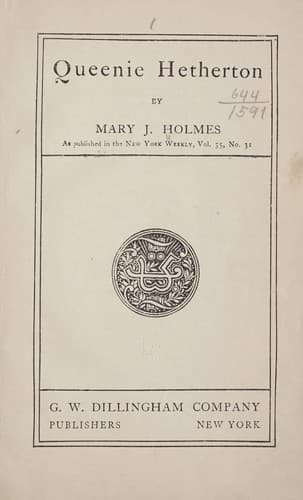
American fiction -- 19th century; Dime novels; Man-woman relationships -- Fiction; Upper class -- Fiction
“If she could impart to me some of her skill, I might do more good and
save more lives,” she said to Pierre, and there was a thought of the
woman in her heart as she bent over the dying negress, wiping the black
vomit from her lips and the sweat-drops from her brow. “_She_ might have
saved her, perhaps,” she said, just as the door opened and the gray
sister came in.
Far gone as was the poor colored woman, she still had enough of sight
and sense to recognize the new-comer, and something like a cry of joy
escaped her as she managed to say:
“Sister Christine!”
In an instant Queenie sprang to her feet, and mother and daughter stood
confronting each other for a moment, neither speaking, but each looking
into the other’s eyes with an eager questioning look. In Christine’s
there was love, and tenderness, and anxiety and fear, all blended
together, while in Queenie’s there was great surprise and something like
gladness, too. She was the first to speak.
“Christine,” she said, “Sister Christine they call you, though I never
dreamed it was you, how came you here, and when?”
Christine told her how and when, and then repeated Margery’s message—to
find her and send her away.
“She says Queenie must not die, and I say so, too. Will you go before it
is too late?” she asked, and Queenie answered her:
“No, my place is here, and I am glad you are here, too. It makes me feel
safer and stronger.”
“Oh, Queenie, Queenie, God bless you for saying even so much,” and the
woman who had stood undaunted by many a death-bed trembled like a leaf
as she snatched Queenie’s hand to her lips, and then went swiftly from
the room, where her services were no longer needed, for while she was
speaking the negress was dead.
That night a telegram went to Margery: “She will not go away, and she
_shall not die_.”
So there was nothing for Margery to do but pray earnestly and
unceasingly for the young girl who seemed to bear a charmed life, so
fearlessly did she meet every peril and overcome every difficulty.
Almost as popular as Sister Christine, she was hailed with delight
everywhere, and more than one owed his recovery to her timely aid. At
last, however, she began to flag a little, and was not quite as strong
to endure as she had been. There were about her no symptoms of the
fever; she was only tired and worn, she said to Pierre, as she sat in
her room one evening. The day had been damp and sultry, and the night
had closed in with rain and fog, while the air was heavy as if laden
with noxious vapors. Queenie had thrown off her street dress and put on
a comfortable wrapper, when there came a quick, sharp ring, and Pierre
brought her a note, or rather a bit of paper torn from a pocket tablet,
and on which was written in French:
“Come immediately to No. 40, —— street. You are needed there.
“CHRISTINE.”
Public-domain text, read in full here on John Shaqi.
Reviews
Reviews
No reviews yet
Be the first to share your thoughts on this work.
Elsewhere in the archive
Join the Discussion
Join the discussion
Sign in to leave a comment or review.
Sign InorCreate an account