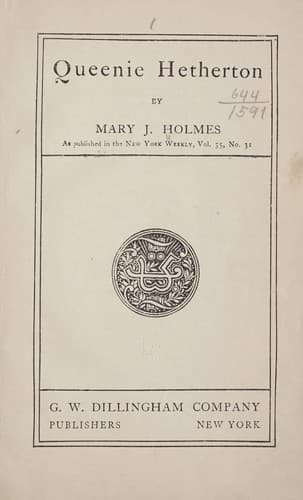
American fiction -- 19th century; Dime novels; Man-woman relationships -- Fiction; Upper class -- Fiction
“Yes,” the dying woman answered, faintly. “I hope I am forgiven, and
that I shall find rest beyond the grave. I used to pray so much in the
cottage when I was alone—pray sometimes all night with my face on the
cold floor. But the peace I asked for would not come. There was always a
horror of blackness before me until I came here, when the darkness has
been clearing, and now there is peace and joy, for I feel that God
forgives me all my sin, and you, my child, have forgiven me too, and
called me _mother_, and Phil is alive and safe. I’ve nothing more to
live for, and I am so glad to die.”
She talked but little after that, and when she did speak her mind was
wandering in the past, now at Chateau des Fleurs, now in Rome, where she
watched by her mistress’ bedside, but mostly in Marseilles, where her
baby was born, “her darling little girl baby,” whom she bade Queenie be
kind to when she was gone. Then she talked of Margery and Paris, and the
apartments in the Rue St. Honore, until her voice was only a whisper,
and Queenie could not distinguish a word. She was dying very fast, and
just at the last, before her life went out forever, Queenie bent over
her, and kissing her softly, whispered:
“Mother, do you know that I am here—Queenie—your little girl?”
“Yes, yes,” she gasped, and a look of unutterable love and satisfaction
shone in the eyes which looked up at Queenie. “_I know_ you are
Queenie—the baby born at Marseilles—my own—and you kiss me and call me
_mother_. God bless you, my child, and make you very happy. I am glad
for your sake that I am going away. Good-by, my darling, good-by!”
She never spoke again, though it was an hour or more before Queenie
loosed her hold of the hand which clung so tightly to hers, and closing
the eyes which looked at her to the last, smoothed the bed-clothes
decently, and then going out to Pierre, who was waiting in the hall,
told him that all was over.
* * * * *
Sister Christine was dead, and there was mourning for her in the city
where she was so well known, and where her kindness and gentleness and
courage had won her so many friends, some of whom followed her remains
to their last resting-place, and wept for her as one long known and well
beloved. Every respect which it was possible under the circumstances to
pay her was paid to her. Many gathered about the grave where they buried
her, just after the sun setting on the same day of her death. It was
Queenie who prepared her for the coffin, suffering no other hands to
touch her but her own.
“She nursed me when I was a baby, and I must care for her now,” she said
to Sister Agatha, when she remonstrated with her and offered to take the
task from her hands.
And to Queenie it was a mournful pleasure thus to care for the woman who
had been her mother, and who, she felt, was truly good and repentant at
the last.
Public-domain text, read in full here on John Shaqi.
Reviews
Reviews
No reviews yet
Be the first to share your thoughts on this work.
Elsewhere in the archive