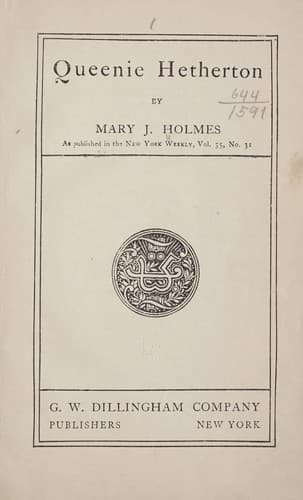
American fiction -- 19th century; Dime novels; Man-woman relationships -- Fiction; Upper class -- Fiction
Margery’s little phaeton, which she had bought for her own use, was
standing before the Knoll, where she was calling, and where Grandma
Ferguson was spending the afternoon with her step-daughter, when the
telegram was received, and thus the parties most interested had the news
at the same time. And they were not greatly surprised, except at the
place from which the telegram was sent. How came Phil in Tennessee, when
they supposed him to be in Florida? It was Margery who explained to
them, then, what she had purposely withheld for the sake of sparing them
the anxiety they would have felt had they known that not only was
Queenie in the midst of the yellow fever at Memphis, but that Phil was
going there, too. Queenie had written her immediately after Christine’s
death, and had told her of Phil’s illness, but added that he was past
all danger, and there was no cause for alarm. Margery had wept in
silence over the sad end of one whom she had loved as a mother, even
after she knew the true story of her parentage. But, like Phil, she felt
that it was better so, that by dying as she did Christine had atoned for
the past even to Queenie, who must necessarily be happier with her dead
than she could have been with her living. That Phil should have taken
the fever so soon filled Margery with dismay lest he might have a
relapse, or Queenie be smitten down, and her errand to the Knoll that
afternoon was to tell her cousins, Ethel and Grace, the truth, and with
them devise some means of getting the two away from the plague-smitten
town. She had told them of Christine’s death, but did not say how she
received her information, and they were wondering why they did not hear
from Phil, who must have been some days at Magnolia Park, when his
telegram was brought in, and they heard for the first time that Queenie
had been a nurse in Memphis, and of her falling in with Phil through
Christine, but for whom he would have died. For a few moments they
almost felt as if he were dead, and Mrs. Rossiter’s face was very white
as she listened to Queenie’s letter, which Margery read, and in which
were so many assurances of his safety that her fears gradually subsided
and she could at last speak calmly of his marriage, of which she was
very glad. It was sure to take place some time, she knew, and as Queenie
ought to be with him during his convalescence, they could not have
managed better than they did. But she was not willing to have them
remain away from her any longer; they must come home at once, and she
wrote to that effect to Phil, welcoming Queenie as a daughter whom she
already loved, and insisting upon their immediate return to Merrivale.
This letter Phil received in the heyday of his first married days, when
he was perfectly happy with Queenie, who was as sweet, and loving, and
gentle as a new bride well could be.
Public-domain text, read in full here on John Shaqi.
Reviews
Reviews
No reviews yet
Be the first to share your thoughts on this work.
Elsewhere in the archive
Join the Discussion
Join the discussion
Sign in to leave a comment or review.
Sign InorCreate an account