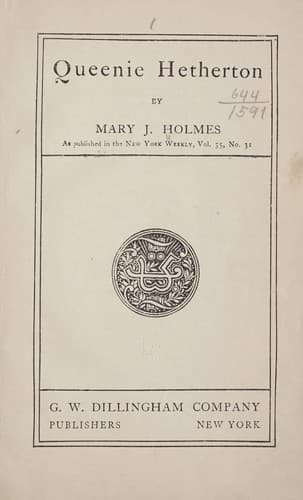
American fiction -- 19th century; Dime novels; Man-woman relationships -- Fiction; Upper class -- Fiction
It was late in November when Phil and Queenie started at last for their
Florida home, where, during the holidays, they were joined by Margery,
and where a little later Mr. Beresford came to claim the hand of his
bride, for Margery was to be married at Magnolia Park, and the ceremony
took place quietly one January evening, when the air was as soft and
mild as the air of June at the North, and the young moon looked down
upon the newly wedded pair. There was a short visit to the St. James,
where Margery and Queenie reigned triumphant as belles for a few weeks,
and then won fresh laurels at St. Augustine and Palatka. By this time
Mr. Beresford’s business necessitated his return to the North, but as
Phil had no business except to oversee the negroes, and as these did not
need overseeing then, he and Queenie tarried longer, and together
explored the Ocklawaha and the upper St. John’s, and fired at
alligators, and camped out for two or three days on the Indian River,
and hunted, and fished, and were almost as happy as were the first pair
in Eden before the serpent entered there.
All this was good for Phil, whose constitution had received a great
shock from his long illness in Africa, and who thus gained strength and
vigor for the new life before him—that of improving and bringing up
Magnolia Park, which had so long run to waste.
It is more than two years now since Queenie and Phil were married, and
last winter they were at Hetherton Place, where a second Queenie
Hetherton lay in its cradle and opened its big blue eyes wonderingly at
the little lady who bent over it so rapturously, and called herself its
“auntie.” Queenie has no children, but she seems so much a child
herself, and looks so small beside her tall husband, who can pick her up
and sit her on his shoulder, or, as he says, “put her in his pocket,”
that a baby would look oddly in her arms. Bright, mirthful, and variable
as the April sunshine, she goes on her way, happy in the love which has
crowned her so completely, and not a shadow crosses her pathway, except
when she remembers the past, which at one time held so much bitterness
for her. Then for a moment her eyes grow darker, and with a sigh she
says, “The worst of all was losing faith in father.”
There is a tall monument to his memory in Merrivale, and a smaller, less
pretentious one marks the grave of Christine in Memphis, erected “by her
daughters.” This was Margery’s idea, “for,” she said to Queenie, “she
was to all intents and purposes my mother—the only one I ever knew.”
Public-domain text, read in full here on John Shaqi.
Reviews
Reviews
No reviews yet
Be the first to share your thoughts on this work.
Elsewhere in the archive
Join the Discussion
Join the discussion
Sign in to leave a comment or review.
Sign InorCreate an account