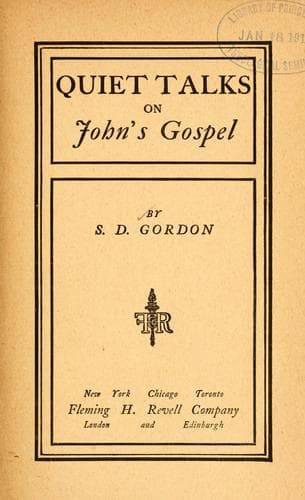
Quiet Talks on John's GospelGordon, S. D. (Samuel Dickey)
Religion
Quiet Talks on John's Gospel
Gordon, S. D. (Samuel Dickey)
Bible. John -- Criticism, interpretation, etc.
They keep up the forms by taking Jesus to Annas the real Jewish ruler of
the nation. But it is simply an opportunity for the coarseness of their
hate to vent itself upon His person. They pretend an examination here in
the night's darkness suited to their deeds. He quietly reminds them of
the frank openness of all His teachings.
Meanwhile John's friendly act has gotten Peter entrance. The attitude of
the two men is in sharpest contrast. John is avowedly Jesus' friend,
regardless of personal danger. Peter just the reverse. And the hate of
the leaders has soaked into all their surroundings even down to the
housemaids. And John notes how exactly Jesus foreknew all, even to a
thrice-spoken denial before the second crowing of a cock.
Now comes the great Pilate phase. It was the intense malignity of their
hate that made them bother with Pilate. They could easily have killed
Jesus and Pilate would never have concerned himself about it. But they
couldn't have put Him to such exquisite suffering and such shameful
indignity before the crowds as by the Roman form of death by
crucifixion.
Clearly there is a hate at work _behind_ theirs. Their hate is
distinctly _inhuman_. Is _all_ hate? There's an unseen personal power in
action here set on spilling out the utmost that malignant hate can upon
the person of Jesus. But these men are cheerful tools. Hate is tying its
hardest knot with ugliest black thread on the end of its opportunity.
This is Pilate's opportunity and he seems to sense it. And a struggle
begins between conscience and cowardice, between right action with an
ugly fight for it, and yielding to wrong with an easy time of it.
Clearly he feels the purity and the personal power of this unusual
prisoner. The motive of envy and hate under their action is as plain to
his trained eyes.
Twice the two men, Pilate and Jesus, are alone together. Did ever man
have such an opportunity, personally, and historically? With rare touch
and winsomeness Jesus woos. And Pilate feels it to the marrow under all
his rough speech. His repeated attempts with the leaders make that
clear. But cowardice gripped him hard. It's a way cowardice has.
The name of Caesar conjures up fears,--loss of position, of wealth, of
reputation, maybe of life itself. He surrenders. Conscience is slain on
the judgment seat. Cowardice laughs and wins. A sharp fling brings a cry
of allegiance to Caesar from their reluctant throats, as their hatred
wins the day. He strikes them back an ugly blow as He surrenders. That
reluctant Caesar cry told out the intensity of their hate. They hated
Caesar much, but they hated Jesus immeasurably more. They gulp down
Caesar to be able to vent their spleen upon Jesus.
Public-domain text, read in full here on John Shaqi.
Reviews
Reviews
No reviews yet
Be the first to share your thoughts on this work.
Elsewhere in the archive
Join the Discussion
Join the discussion
Sign in to leave a comment or review.
Sign InorCreate an account