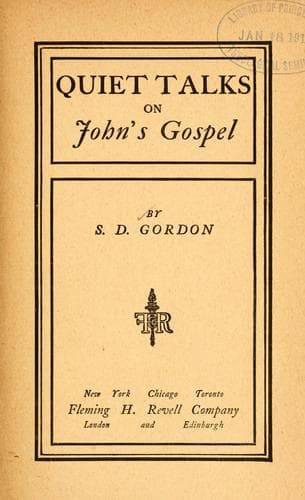
Quiet Talks on John's GospelGordon, S. D. (Samuel Dickey)
Religion
Quiet Talks on John's Gospel
Gordon, S. D. (Samuel Dickey)
Bible. John -- Criticism, interpretation, etc.
And if the mother be of the thoughtful brooding kind, she says nothing,
but gets a hand mirror, and holds it before the child's face. That will
always get a child's attention. And the boy looks; he sees his dirty
face reflected. The blank astonishment on his face can't be put into
words. It tells the radical upsetting revolution in his thought on that
subject. How could it have happened that his face got into that
condition! And the washing process is yielded to at least; possibly even
asked for.
That's what the law did and does. It showed man his face, his heart, his
need. It brings upsetting revolutionary ideas regarding one's self.
There it stops. That's its limit. Then the Man who in Himself is grace
and truth does the rest.
The Spokesman of God.
Then John quietly, deftly draws the line around to the starting point in
that first tremendous statement. He completes a circle perfect in its
strength and beauty and simplicity, as every circle is. If we follow the
order of the words somewhat as John wrote them down, we find the bit of
truth coming in a very striking, as well as in a fresh way. "_God no
one has ever, at any time, seen_."
That seems rather startling, does it not? What do these older pages
say? Adam talked and walked and worked with God, and then was led to
the gate of the garden. God appeared to Abraham, and gave him a
never-to-be-forgotten lesson in star study. Moses spent nearly six weeks
with Him, twice over, in the flaming mount, and carried the impress of
His presence upon his face clear to Nebo's cloudy top.
The seventy elders "saw the God of Israel, and did eat and drink," the
simple record runs. And young Isaiah that morning in the temple, and
Ezekiel in the colony of exiles on the Chebar, and Daniel by the Tigris
at the close of his three weeks' fast,--these all come quickly to mind.
John's startling statement seems to contradict these flatly.
But push on. John has a way of clearing things up as you follow him
through. Listen to him further: The only-begotten God who is in the
bosom of the Father--_He_ has always been the _spokesman_ of God. Look
into that sentence of John's a little. It seems quite clear, clear to
the point of satisfying the most critical research, that John wrote down
the words, "the only-begotten _God_." The contrast in his mind is not
between "God," and the "only begotten Son." It is a contrast whose
verbal terms fit with much nicer exactness than that. It is a contrast
between "God" and the "only-begotten God."
There is only one such person whichever way unity. They tell the whole
story hanging at the end of John's pen. This little bit commonly called
the prologue is a gem of simplicity and compactness.
It is John's Gospel in miniature, even as John's Gospel is the whole
Bible story in miniature. You can see the whole of the sun reflected in
a single drop of water. You can see the whole of both Father and Son in
the action of love in these simple opening lines of John's Gospel.
Public-domain text, read in full here on John Shaqi.
Reviews
Reviews
No reviews yet
Be the first to share your thoughts on this work.
Elsewhere in the archive
Join the Discussion
Join the discussion
Sign in to leave a comment or review.
Sign InorCreate an account