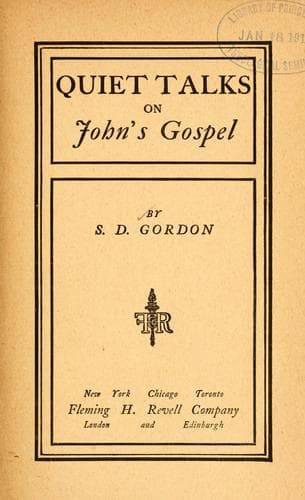
Quiet Talks on John's GospelGordon, S. D. (Samuel Dickey)
Religion
Quiet Talks on John's Gospel
Gordon, S. D. (Samuel Dickey)
Bible. John -- Criticism, interpretation, etc.
Have you ever been walking down a country road till, weary and thirsty,
you stopped at an old farmhouse and refreshed yourself at the
old-fashioned well, with its bucket and long sweep? And as you rested a
bit by the well you wondered how deep it was. It didn't look deep at
all. The water was near, and it was so clear and sweet and refreshing,
and so easy to get at for a drink.
_Is_ it deep? So you fish a rather long bit of string out of your
pocket, and tie it to a bit of stone you find lying close by. And you
let the stone down, and down, and down, till you are surprised to find
that the well is deeper than your string is long.
Well, John's opening bit is just like that. It seems very simple, easily
understood at first flush in the mere statements made. The water is near
the top. You easily drink. And you are refreshed. But when you try to
find out how deep it is, you are startled to find that it is clear over
your head.
But it is _never over your heart_. It is too deep for you to grasp and
understand. You never touch bottom. _But_ it's never beyond
heart-understanding. You can sense and feel and love. You can open the
sluice-gates into your heart, and have the blessed flood-tide lift and
lift and bear you aloft and along. You can _love._ And that is the whole
story.
Was John an artist? Is he making a rare painting for us here? Is he
studying perspective, shading and spacing, to an exquisite nicety that
is revealed in the very way he puts words and sentences and paragraphs
together? I do not know. And if any of you think the thing I am about to
speak of is due to a mere mechanical chance of the pen, I'll not quarrel
with you. Though I shall still have my own personal thought in the
matter.
But will you notice this? John begins his prologue with a description of
a wonderful personality. He ends it with another description of this
same personality. Both descriptions are rare in beauty and boldness, in
simplicity and brevity. And right midway between the two, at almost the
exact middle line of the reading, at what is the artistic center, stands
the word "_came_."
That word "came" gathers up into itself and tells out to you the whole
story about this twice-described personality. "He came" John says.
That's the whole thing. First the _He_ fills your eye, and then what He
did--_came_. And as you step off a bit for better perspective, and
change your personal position this way and that to get the best light,
you find the picture standing out before your awed eyes.
Public-domain text, read in full here on John Shaqi.
Reviews
Reviews
No reviews yet
Be the first to share your thoughts on this work.
Elsewhere in the archive
Join the Discussion
Join the discussion
Sign in to leave a comment or review.
Sign InorCreate an account