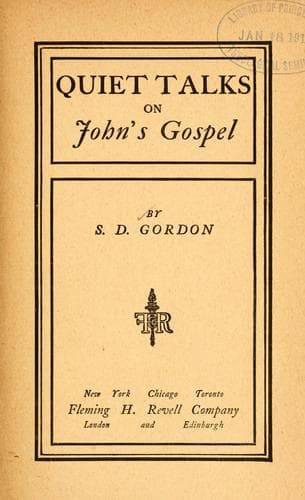
Quiet Talks on John's GospelGordon, S. D. (Samuel Dickey)
Religion
Quiet Talks on John's Gospel
Gordon, S. D. (Samuel Dickey)
Bible. John -- Criticism, interpretation, etc.
And the reason is plain. Jerusalem is Israel. It is the nation. Jesus is
wooing the _nation_ through its leaders. Why? For the nation's sake? for
Israel's sake? Yes and no. Because these Jews were favourites of God?
Distinctly _no_, though so highly favoured they had been in the wondrous
mission entrusted to them. But because Israel was the gateway to a world
Yes, for Israel's sake. _Through_ this gateway, so carefully prepared
when every other gate was closing, _through_ this out to a world--this
was the plan of action. And this will yet be found to be the plan.
Through a Jewish gateway the King will one day go out to touch His
world. This is the geography of John's story.
The action of the story swirls largely, too, about the great national
feasts, the Passovers, the Tabernacles or harvest-home feast of the
autumn, and one called "the Dedication," not elsewhere spoken of. To
these came great crowds of pilgrim Jews from all quarters of the world,
speaking many languages beside their national Hebrew, giving large
business, especially to money-brokers and traders in the animals and
birds used in the sacrifices. That classical Pentecost Chapter of Acts
gives the wide range of countries and of languages represented by these
pilgrim thousands. These feasts are the central occasions of John's
story.
_The time_ begins with John's preaching in the Jordan bottoms and
reaches up practically to the evening of the betrayal. It is commonly
reckoned three and a half years. That is, there are some months before
that first Passover, and then the events run through and up to the
fourth Passover, reckoning the unnamed feast of chapter five as a
Passover. This is the chronology of John's Gospel. John's Gospel gives
the only clue to the length of Jesus' ministry.
There are three groups _of persons_. There are _the Jews_. That is one
of John's distinctive phrases. By it he means as a rule the official
leaders of the nation, whom in common with the other writers he also
designates by their party names, Pharisees, Scribes, Chief Priests, and
so on. Among these the name of Caiaphas stands out, and later Annas.
Then there are _the crowds_, the masses of people that flock together in
any new stirring movement. There are Galilean crowds, feast-time crowds
including the great numbers of foreign pilgrim Jews, city crowds, and
country crowds. They gather to John's preaching. They gather in great
numbers in Jerusalem, and on the Galilean visits. They are easily
impressionable, swayed by subtle crowd-contagion, stirred up and played
upon cunningly by the opposition leaders.
Public-domain text, read in full here on John Shaqi.
Reviews
Reviews
No reviews yet
Be the first to share your thoughts on this work.
Elsewhere in the archive
Join the Discussion
Join the discussion
Sign in to leave a comment or review.
Sign InorCreate an account