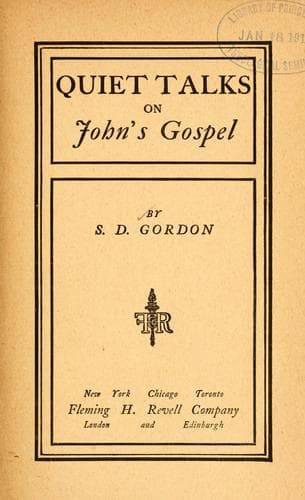
Quiet Talks on John's GospelGordon, S. D. (Samuel Dickey)
Religion
Quiet Talks on John's Gospel
Gordon, S. D. (Samuel Dickey)
Bible. John -- Criticism, interpretation, etc.
They were eye and ear-witnesses of the stirring events of those last
days in Jerusalem. The stupendous story of the raising of the man out in
the Bethany suburb was the talk of the city. And then there was that
intense scene of the kingly entry into the city amid the acclaiming
multitudes. They knew of the official opposition, and the public
proclamation against Jesus. They breathed the Jerusalem air. That put
them in touch with the whole situation.
Now notice keenly they seek a personal interview with Jesus. This is the
practical outcome of the situation _to them_. It reminds one of that
other man, under similar conditions though less intense, at an earlier
stage, cautiously seeking a night interview. Their desire tells not
curiosity but earnestness, and the very earnestness reveals both purpose
and attitude towards Jesus.
And this is made the plainer by the very words they use as they seek out
the likeliest man of the Master's inner circle to secure the coveted
interview. They say, "Sir, _we would see Jesus_." The whole story of
conviction, of earnestness, of decision, is in that tremendous little
word "would." It was their will, their deliberate choice, to come into
personal relations with this Man of whom they were hearing so much.
And it seems like a direct allusion to that tremendous word, and an
answer to it, when Jesus, in effect, in meaning, says, "if any man
_would_ follow Me." Both the coming under such circumstances, and the
form of the request, seem to tell the attitude of these men towards
Jesus and their personal purpose regarding Him. It would be altogether
likely that they accompany Philip as he seeks out Andrew. It would be
the natural thing. And so they are with Philip and Andrew as they come
to tell Jesus.
Then this would be the setting of these memorable intense words that
Jesus now utters.[71] He senses at once the request and the earnest
purpose of these men seeking Him out. It is for them especially that
these words are spoken. And if, as some thoughtful scholars think, Jesus
spake here, not in His native Aramaic, but in the Greek tongue, it gives
colouring to the supposition. The intense earnestness of His words, and
the revealing of the intense struggle within His spirit as He breathes
out the simple prayer,--all this is a tacit recognition of the spirit of
these Greeks.
The parallel is striking with the Nicodemus interview where no direct
mention is made of the faith that later events showed was unquestionably
there. It seems like another of those silences of John that are so full
of meaning.[72] And the silence seems, as with Nicodemus, to mean the
acquiescence of the inquirers in the message they hear.
This then would seem to be the reply to the request. They have indeed
seen Jesus. And they accept it and Him, as most likely they linger
through the Passover-days at hand and then turn their faces homeward.
And so the warm wooing has drawn out this warm response from the
cultured Greek world.
Public-domain text, read in full here on John Shaqi.
Reviews
Reviews
No reviews yet
Be the first to share your thoughts on this work.
Elsewhere in the archive
Join the Discussion
Join the discussion
Sign in to leave a comment or review.
Sign InorCreate an account