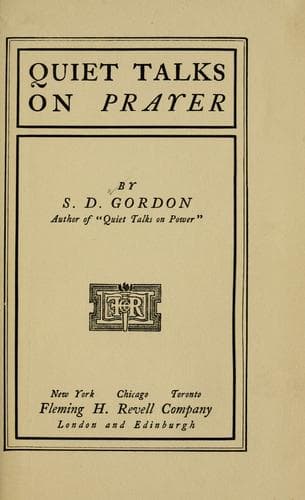
Quiet Talks on PrayerGordon, S. D. (Samuel Dickey)
Religion
Quiet Talks on Prayer
Gordon, S. D. (Samuel Dickey)
Prayer -- Christianity
Now the second stage of wide reading is this: fit these parts together.
Fit the poetry and the prophecy into the history. Do it on your own
account, as though it had never been done. It has been done much better
than you will do it. And you will make some mistakes. You can check those
up afterwards by some of the scholarly books. And you cannot tell where
some parts belong. But meanwhile the thing to note is this: you are
absorbing the Book. It is becoming a part of you, bone of your bone, and
flesh of your flesh, mentally, and spiritually. You are drinking in its
spirit in huge draughts. There is coming a new vision of God, which will
transform radically the reverent student. In it all seek to acquire _the
historical sense_. That is, put yourself back and see what this thing, or
this, meant to these men, as it was first spoken, under these immediate
circumstances.
And so push on into the New Testament. Do not try so much to fit the four
gospels into one connected story, dovetailing all the parts; but try
rather to get a clear grasp of Jesus' movements those few years as told by
these four men. Fit Paul's letters into the book of Acts, the best you
can. The best book to help in checking up here is Conybeare and Howson's
"Life and Letters of St. Paul." That may well be one of the books in your
collection.
You see at once that this is a method not for a month, nor for a year, but
for years. The topical and textual study grow naturally out of it. And
meanwhile you are getting an intelligent grasp of this wondrous classic,
you are absorbing the finest literature in the English tongue, and
infinitely better yet, you are breathing into your very being a new, deep,
broad, tender conception of _God_.
<u>A Mirror Held up to God's Face.</u>
It is simply fascinating too, to find what light floods these pages as
they are read back in their historical setting, so far as that is
possible. For example turn to the third Psalm, fifth verse,
"I laid me down and slept;
I awaked; for the Lord sustaineth me."
I was brought up in an old-fashioned church where that was sung. I knew it
by heart. As a boy I supposed it meant that night-time had come, and David
was sleepy; he had his devotions, and went to bed, and had a good night's
sleep. That was all it had suggested to me.
Public-domain text, read in full here on John Shaqi.
Reviews
Reviews
No reviews yet
Be the first to share your thoughts on this work.
Elsewhere in the archive
Join the Discussion
Join the discussion
Sign in to leave a comment or review.
Sign InorCreate an account