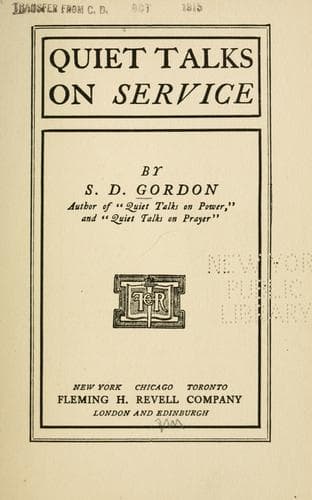
Quiet Talks on ServiceGordon, S. D. (Samuel Dickey)
Religion
Quiet Talks on Service
Gordon, S. D. (Samuel Dickey)
Christian life
There are two "don't-worry" chapters in this old Bible, one in the Old
Testament and one in the New. In the Old Testament is the Thirty-seventh
Psalm with its oft-repeated "fret not." The word under that English phrase
"fret not" is significant. It is so blunt as to sound almost like a bit of
American slang. Literally it means "don't get hot." The New Testament has
the sixth chapter of Matthew with Jesus' own words. One should be careful
here to note the better reading of the revision. The old version says
"take no thought," and that has been misunderstood by many who have not
thought about its meaning. The newer translations are truer to the meaning
on Jesus' lips. Do not take _anxious_ thought, "be not anxious." But apart
from these two chapters there is a phrase running through these pages
clear through the whole Book, a phrase shot through, piercing everywhere,
even as the glorious sunlight pierces through the thick cloud and fog. I
mean the phrase "fear not." All worry roots down its tenacious tendrils
in fear.
A Fence of Trust.
It will help to understand just what worry is. It is always an advantage
to get an enemy clearly defined and keep it so, so you can hit it harder,
and make every blow tell on a vital part of its anatomy.
Worry is not concern, but distress of mind. Some one said to me at the
close of a talk on worry, "some folks ought to worry more." Of course he
meant that some people should bear their share of the responsibilities of
life, instead of selfishly and lazily shirking them. There is a proper
concern about matters for which we are responsible. A man never makes a
good speech unless there is a feeling of concern, of apprehension lest
there be failure in that for which he is pleading. A strong sensitive
spirit feels the responsibility and does the best to meet it. Worry is
mental distress. It is sinking under the sense of responsibility. It is
_yielding_ to the fear that there may be failure, instead of gripping the
lines and whip and determining to ride down the chance of its coming.
Sometimes worry is carrying to-morrow's load with to-day's strength;
carrying two days in one. It is moving into to-morrow ahead of time.
There is just one day in the calendar of action; that's to-day. Planning
should include a wide swing of days; wise planning must. But action
belongs to one day only, to-day.
"Build a little fence of trust
Around to-day;
Fill the space with living work
And therein stay;
Look not through the sheltering bars
Upon to-morrow;
God will help thee bear what comes
Of joy or sorrow."
"Live for to-day, to-morrow's sun
To-morrow's cares will bring to light,
Go like the infant to thy sleep
And heaven thy morn shall bless."
A Lord of the Harvest.
Public-domain text, read in full here on John Shaqi.
Reviews
Reviews
No reviews yet
Be the first to share your thoughts on this work.
Elsewhere in the archive
Join the Discussion
Join the discussion
Sign in to leave a comment or review.
Sign InorCreate an account