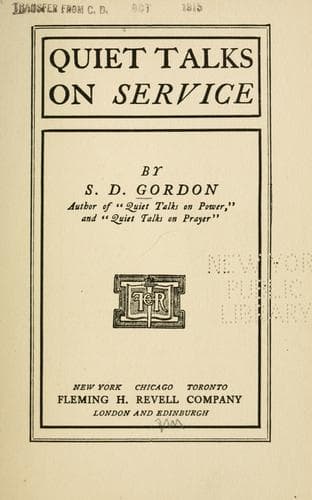
Quiet Talks on ServiceGordon, S. D. (Samuel Dickey)
Religion
Quiet Talks on Service
Gordon, S. D. (Samuel Dickey)
Christian life
Then I marked a change. The lines of tension in her face relaxed. A new
quiet light came into her eye. There seemed a gentle intangible, but very
sure, peace breathing about her. And I knew there was no change in him. So
one day in conversation I ventured to ask about the change. And I shall
always remember the gentle voice and the quiet strength with which she
said, "I have given him over to my Father. And I know He will not fail
me. I am still praying, of course, as ever, and I am _trusting_ for him."
She had been carrying a load that she should not have been carrying. And
now while the mother-heart was still concerned as much as ever, the sense
of assured victory brought the change in her spirit.
Sometimes worry is fretting over past mistakes; it is chafing about what
we do not understand, or about plans of _ours_ that have failed. A good
deal of worry comes from pride and over-sensitiveness. The roots here, it
will be noticed, of all alike are down in our own failures, our own
selves. And there would be cause for more worry if we had only ourselves.
But we have _a Father_.
A very great deal of worry is wholly due to physical causes. Overworked
nerves always see things distorted. Huge phantom shapes loom up before us.
Overwork always makes a sensitive spirit worry, and worry usually makes us
overwork until we drop from exhaustion. When the cause is here, there are
some simple _human_ helps. Some--a good bit--of _God's_ fresh air will
work wonders. Even good people seem unchangeably opposed to _God's_ air,
and insist on breathing old, worn-out, used-up second-hand air. God would
be greatly glorified if housekeepers and church sextons were given a
practical course in the use of fresh air, God's air. With that should be
simple food, and simple dress, and abundant sleep, and simple standards of
life.
Worry is utterly _useless_. It never serves a good purpose. It brings no
good results. "Which of you can by being anxious add a single span to the
measure of his life?" Jesus asks in that sixth of Matthew. But much more
can be said. _It brings bad results_. The revision brings out the clear,
simple meaning of the Thirty-seventh Psalm, eighth verse. The old version
seems a bit puzzling, "Fret not thyself in anywise to do evil." The
revision reads, "Fret not thyself, it tendeth only to evil doing." The
results of worrying are always bad. The judgment is impaired. One cannot
think so clearly nor see so clearly. The temper is ruffled. The door is
quickly opened to worse things.
Public-domain text, read in full here on John Shaqi.
Reviews
Reviews
No reviews yet
Be the first to share your thoughts on this work.
Elsewhere in the archive
Join the Discussion
Join the discussion
Sign in to leave a comment or review.
Sign InorCreate an account