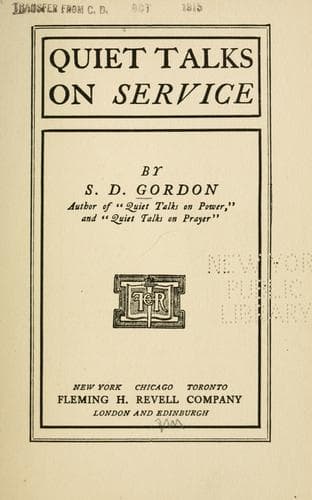
Quiet Talks on ServiceGordon, S. D. (Samuel Dickey)
Religion
Quiet Talks on Service
Gordon, S. D. (Samuel Dickey)
Christian life
Our old Tarsus and Antioch friend and leader has written a special word
about this matter of being chosen for service. It is in his first letter
to the recently organized church at Corinth. It is really his second
letter, for he seems to have written one before it that has not been
preserved.[23] There were some very serious matters in this new church
requiring strong treatment by its much-loved founder. Among them was one
about service.
There were some who had gifts in service that seemed more attractive and
desirable than others had, it might be said more showy. And their
brethren, not free from the old worldly spirit, were envious and jealous.
And these who had such gifts were not free from a boasting spirit.
Factions or parties had arisen as a result. It was the bad world spirit of
competition and rivalry in among Christ's followers where it should never
come, yet where it still does come. In writing this letter Paul throughout
blends great plainness and common sense with great tenderness.
In the beginning of his letter he calls attention to the fact that there
are not many among them of those who were reckoned by the world's
standards as wise or mighty or noble. On the contrary, in choosing His
leaders God had purposely chosen those reckoned by the world's standards
foolish that He might show plainly the shallowness of what they deem wise.
And so things reckoned weak had been chosen to give the conception of
what true strength is. And things even base, and despised, and not counted
at all had been used that so men might learn the God-standards of wisdom
and strength and honor and of what is worth while. The purpose being that
men should quit glorying in themselves and glorify Him from whom
everything had come, and was ever coming.
The passage has oftentimes been quoted as though God prefers weakness;
never put so bluntly as that perhaps, but plainly meaning that. That of
course is not true. God wants the best we have. He needs the best. And for
leadership often His plans must wait till a man of the sort needed can be
gotten. And gotten frequently means broken, shattered, and then made over
wholly new, that the native strength may be used according to true
standards.
Jacob was chosen rather than his elder brother Esau, not because of
Jacob's goodness but because of Esau's weakness. God was narrowed to these
two grandsons in carrying out the promise to Abraham. Jacob was
contemptible in his moral dealings, but he had qualities of leadership
wholly lacking in his brother. His moral character was a serious
hindrance. God had to handle him heroically before He could get the use of
his stronger mental equipment. Jacob had to get a bad throw-down before he
would be willing to let God have His way. His body must be weakened
before his mental power would yield. That was the weakness of his
stubbornness. Stubbornness is strength not strong enough to yield.
God's Use of Weak Things.
Public-domain text, read in full here on John Shaqi.
Reviews
Reviews
No reviews yet
Be the first to share your thoughts on this work.
Elsewhere in the archive
Join the Discussion
Join the discussion
Sign in to leave a comment or review.
Sign InorCreate an account