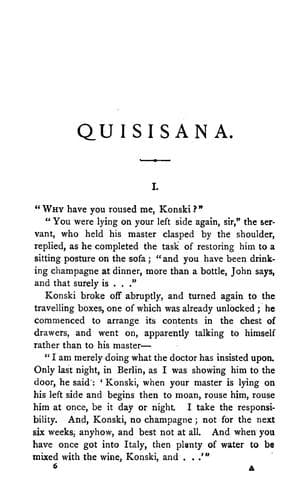
"So he lay down, and I put the rug over him, sir, and, oh--I'll never
forgive myself for it; but all day long I had been running backward and
forward about these things of mine, and then at last the long walk at
night to the telegraph-office, and perhaps the champagne had gone to my
head a bit, since I am sure, that I had not sat for five minutes before
I was asleep. And when I woke it was not half-past one, but half-past
two, so that I was regular frightened like. But as the master was
a-sleeping calm and steady, I thought, even as I was standing quite
close to him, that it was a pity to wake him, even though he was lying
on his left side again, which formerly he could not bear at all, and
which you, sir, had forbidden so particularly. I mind of our first
evening in Rinstedt, sir, but then he did wake up again ... and now he
is dead."
Konski was crying bitterly. The doctor held out his hand to him.
"It is no fault of yours. Neither you nor I could have kept him alive.
Now, leave me here alone; you may wait in the next room."
After Konski had left, the doctor went to the little round table on
which the empty bottle and two glasses were standing, one empty, one
half-full. Above the sofa, to the right and left, were gas-brackets,
with one lighted jet on either side. He held the half-full glass to
the light and shook it. Bright beads were rising from the clear,
liquid.
He put the glass down again, and murmured--
"He never spoke an untruth! It was in any case solely a question of
time. He drank his death-draught six months ago. The only wonder is
that he bore it so long."
Erna's letter was lying upon the table. The doctor read it almost
mechanically.
"Pretty much as I thought!" he muttered. "Such a clever and, as it
would seem, large-hearted girl, and yet--but they are all alike!"
A scrap of paper, with something in Bertram's hand writing caught his
eye. It was the German telegram.
"All hail--happiness and blessing--to-day and for ever--for my darling
child in Quisisana."
The doctor rose, and was now pacing up and down the chamber with folded
arms. From the adjoining room, the door of which was left ajar, he
heard suppressed sobs. The faithful servant's unconcealed grief had
well-nigh unchained the bitter sorrow in his own heart. He brushed the
tears from his eyes, stepped to the couch, and drew the covering back.
He stood there long, lost in marvelling contemplation.
The beautiful lofty brow, overshadowed by the soft and abundant hair,
the dark colour of which was not broken by one silvery thread; the
daintily curved lips, that seemed about to open for some witty saying,
lips the pallor of which was put to shame by the whiteness of the
teeth, which were just visible; the broad-arched chest--what wonder
that the man of fifty had felt in life like a youth--like the youth for
whom Death had taken him.
From those pure and pallid features Death had wiped away even the
faintest remembrance of the woe which had broken the noble heart.
Public-domain text, read in full here on John Shaqi.
Reviews
Reviews
No reviews yet
Be the first to share your thoughts on this work.
Elsewhere in the archive
Join the Discussion
Join the discussion
Sign in to leave a comment or review.
Sign InorCreate an account