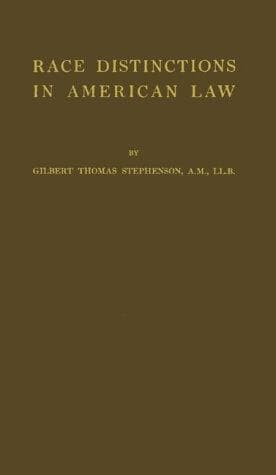
Race Distinctions in American LawStephenson, Gilbert Thomas
History
Race Distinctions in American Law
Stephenson, Gilbert Thomas
African Americans -- Politics and government; Law -- United States -- History; United States -- Race relations
The third incident referred to, though not a matter of legislation, did
much to focus the attention of the country at large upon the question of
the separation of the races in schools. The Twentieth Century Club of
Boston met at luncheon on the 14th of February, 1907, to consider the
situation of Berea College. Dr. Charles W. Eliot, then President of
Harvard University, was one of the speakers. In the course of his
remarks, he said: “If the numbers of whites and blacks were more nearly
equal [in Boston] we might feel like segregating the one from the other
in our own schools. It may be that as large and generous a work can be
done for the Negro in this way as in mixed schools. So the separation of
the races in the Berea schools is not really an abandonment of the
principle, although it may be a departure from the original purpose.
“Perhaps if there were as many Negroes here as there we might think it
better for them to be in separate schools. At present Harvard has about
five thousand white students and about thirty of the colored race. The
latter are hidden in the great mass and are not noticeable. If they were
equal in numbers or in a majority, we might deem a separation
necessary.”[348]
These conservative and guarded words of the head of the University which
has, above all other American institutions of learning, preserved and
encouraged the “open-door policy” toward students of all races, struck
consternation to the radicals of both the white and colored races in the
North and East, and gladdened the hearts of many of the South and West
who are facing their own race problems. One side felt that it had lost
an illustrious standard-bearer; the other, that it had won a strong
ally.
These three incidents show that the separation of the races in schools
is a live question, worthy of an investigation. It is probable that
there are many private and public schools outside of the South which do
not, in fact, admit colored students. Probably there are schools which
would close their doors to white applicants. It may be that there are
actual discriminations against one or the other race in those schools
which claim to make no distinction on account of race or color. But many
such matters as these have not come under the eye of the law, and so
have no place here.
SEPARATION BEFORE 1865
Although one need not consider in detail the laws separating the races
in schools before the Civil War, because the public school system then
was poorly developed, as a rule, and the Negro had not attained the
rights of a citizen in many States, still it is well to look into some
of the antebellum statutes and decisions to find precedents for later
statutes and rulings of the courts upon this subject.
Public-domain text, read in full here on John Shaqi.
Reviews
Reviews
No reviews yet
Be the first to share your thoughts on this work.
Elsewhere in the archive
Join the Discussion
Join the discussion
Sign in to leave a comment or review.
Sign InorCreate an account