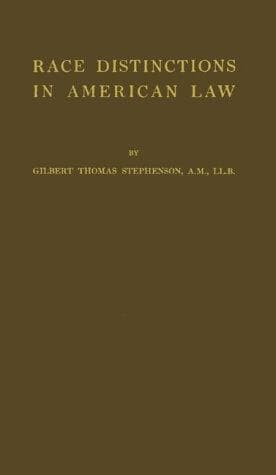
Race Distinctions in American LawStephenson, Gilbert Thomas
History
Race Distinctions in American Law
Stephenson, Gilbert Thomas
African Americans -- Politics and government; Law -- United States -- History; United States -- Race relations
The County Board of Education of Richmond County, Georgia, in 1880,
established a high school for Negroes, but in 1897 it was discontinued
for economic reasons, because the money to educate fifty or sixty
Negroes in the high school would give the rudiments of education to two
hundred of the four hundred young Negroes in the county who were crowded
out. It was understood that the school would be re-opened as soon as
economic considerations permitted. A Negro brought suit against the
board for discrimination against his race in that the white high school
to which the Board made contributions had not been closed also. The
Supreme Court of that State held[492] that the Board had the right to
establish or discontinue high schools when the interests and convenience
of the people require it. There were more white children of the
high-school grade than colored; therefore, the court argued, the Board
was justified in continuing the white high school. The case was appealed
to the Supreme Court[493] of the United States, which affirmed the
decision of the State court. Mr. Justice Harlan, delivering the opinion
of the court, said: “... while all admit that the benefits and burdens
of public taxation must be shared by the citizens without discrimination
against any class on account of their race, the education of the people
in the schools maintained by State taxation is a matter belonging to the
respective States, and any interference on the part of the Federal
authority with the management of such schools cannot be justified except
in the case of clear and unmistakable disregard of rights secured by the
supreme law of the land.”
In general, where separate schools are required, it is said that they
must be equal for both races; but it has been held that it is not an
unjust discrimination to build more imposing school-houses for the many
white children than for the few colored children; to require the
children of one race to walk farther to school than the other, or to
maintain high schools for one race without doing so for the other. Only
a very few States have escaped altogether the question of the separation
of the races in schools. Even where the State statutes have declared
point-blank by statute that there shall be no distinction on account of
race or color, the suits that have arisen in those States show that the
school boards have tried to evade the law.
DIVISION OF PUBLIC SCHOOL FUND
Public-domain text, read in full here on John Shaqi.
Reviews
Reviews
No reviews yet
Be the first to share your thoughts on this work.
Elsewhere in the archive
Join the Discussion
Join the discussion
Sign in to leave a comment or review.
Sign InorCreate an account