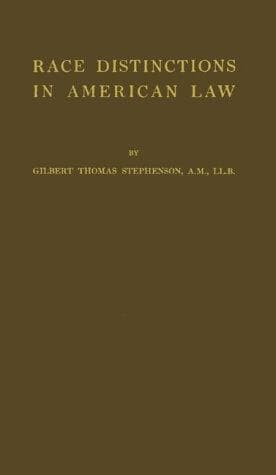
Race Distinctions in American LawStephenson, Gilbert Thomas
History
Race Distinctions in American Law
Stephenson, Gilbert Thomas
African Americans -- Politics and government; Law -- United States -- History; United States -- Race relations
Pruitt v. Gaston Co. Commissioners, 1886, 94 N. C. 709; Riggles v.
City of Durham, 1886, 94 N. C. 800.
Footnote 516:
Art. X, sec. 7.
CHAPTER IX
SEPARATION OF RACES IN PUBLIC CONVEYANCES
There is perhaps no phase of the American race problem which has been
discussed so much within the last decade as the so-called “Jim Crow”
laws, the statutes requiring separate accommodations for white and
colored passengers in public conveyances. This arises largely from the
fact that these legislative enactments are of general concern, while the
other legal distinctions have directly affected only certain classes of
each race. Laws prohibiting intermarriage, for instance, concern only
those of marriageable age; suffrage restrictions apply only to males of
voting age; and statutes requiring separate schools affect immediately
only children and youths; but the laws requiring white and colored
passengers to occupy separate seats, compartments, or coaches concern
every man, woman, and child, who travels, the country over. They affect
not only those living in the States where the laws are in force, but the
entire traveling public. The white man or the Negro in Massachusetts may
not care anything about the suffrage restrictions of South Carolina,
but, if he travels through the South, he must experience the
requirements of the “Jim Crow” laws.
ORIGIN OF “JIM CROW”
The phrase “Jim Crow” has become so inseparably affixed to the laws
separating the races in public conveyances that two States, North
Carolina and Maryland, have indexed the laws on that subject under “J”
in some of their annual statutes. The earliest public use of the phrase
appears to have been in 1835, when Thomas D. Rice, the first Negro
minstrel, brought out in Washington a dramatic song and Negro dance
called “Jim Crow.” The late actor, Joseph Jefferson, when only four
years old, appeared in this dance.[517] In 1841 “Jim Crow” was first
used in Massachusetts to apply to a railroad car set apart for the use
of Negroes.[518] The phrase, then, has a somewhat more dignified origin
than is ordinarily attributed to it by those who have considered it as
only an opprobrious comparison of the color of the Negro with that of
the crow.
DEVELOPMENT OF LEGISLATION PRIOR TO 1875
Public-domain text, read in full here on John Shaqi.
Reviews
Reviews
No reviews yet
Be the first to share your thoughts on this work.
Elsewhere in the archive
Join the Discussion
Join the discussion
Sign in to leave a comment or review.
Sign InorCreate an account