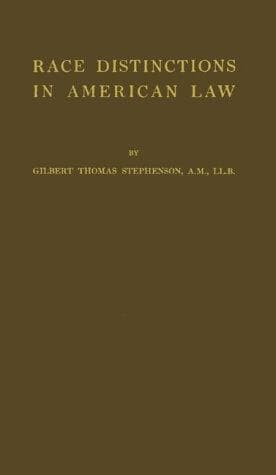
Race Distinctions in American LawStephenson, Gilbert Thomas
History
Race Distinctions in American Law
Stephenson, Gilbert Thomas
African Americans -- Politics and government; Law -- United States -- History; United States -- Race relations
Other Southern States, perhaps, would have undertaken similar
legislation, had the legislatures been left unfettered; but under the
Reconstruction régime, a number of the States even passed laws
prohibiting discrimination against Negroes in public conveyances. In
1870, the Georgia legislature[522] enacted a statute requiring the
railroads in the State to furnish equal accommodations to all, without
regard to race, color, or previous condition, when a greater amount of
fare was exacted than had been exacted before January 1, 1861, which had
been at that time half-fare for persons of color. Texas,[523] in 1871,
repealed the law of 1866 and prohibited public carriers “from making any
distinctions in the carrying of passengers” on account of race, color,
or previous condition, making the violation of the law a misdemeanor
punishable by a fine of not less than one hundred nor more than five
hundred dollars, or imprisonment for not less than thirty or more than
ninety days, or both. In 1873, Louisiana[524] prohibited common carriers
from making any discrimination against any citizen of the State or of
the United States on account of race or color, and went further still by
prohibiting common carriers from other States from making such
discriminations while in the State. Out of this latter provision arose
the great case of Hall v. DeCuir, which will be discussed later. In
1874, Arkansas[525] prohibited any public carrier from making any rules
for the government or control of his business which should not affect
all persons alike, without regard to race or color.
In the meantime, some of the States outside the South were taking
steps to adjust the privileges of persons of color. In 1866,
Massachusetts[526] made it unlawful’“to exclude persons from or
restrict them in ... any public conveyance ... except for good cause.”
The following year, Pennsylvania[527] enacted a statute prohibiting
railroads from excluding persons from their cars or requiring them to
ride in different parts of the cars on account of color or race, also
prohibiting the conductor or other agent of the railroad from throwing
the car off the track to prevent such persons from riding. This law
was passed just a few days before the famous case of West Chester and
Philadelphia Railway Company v. Mills was decided, which case will
also be discussed later.
A statute of Delaware[528] of 1875, as has been seen, declared that the
carriers of passengers might make such arrangements in their business as
would, if necessary, assign a particular place in their cars, carriages,
or boats to such of their customers as they might choose to place there,
and whose presence elsewhere would be offensive to the major part of the
traveling public, where their business was conducted; but the
accommodations must be equal for all if the same price for carriage was
required from all.
LEGISLATION BETWEEN 1865 AND 1881
Public-domain text, read in full here on John Shaqi.
Reviews
Reviews
No reviews yet
Be the first to share your thoughts on this work.
Elsewhere in the archive
Join the Discussion
Join the discussion
Sign in to leave a comment or review.
Sign InorCreate an account