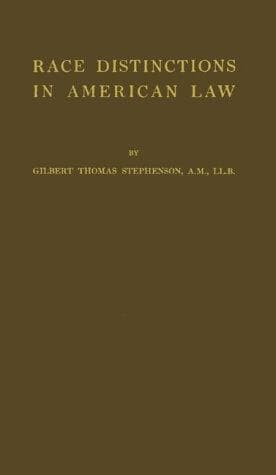
Race Distinctions in American LawStephenson, Gilbert Thomas
History
Race Distinctions in American Law
Stephenson, Gilbert Thomas
African Americans -- Politics and government; Law -- United States -- History; United States -- Race relations
The second section of the Fourteenth Amendment, proposed June 16, 1866,
and declared in force June 28, 1868, reads: “Representatives shall be
apportioned among the several States according to their respective
numbers, counting the whole number of persons in each State, excluding
Indians not taxed. But when the right to vote at any election for the
choice of electors for President and Vice-President of the United
States, Representatives in Congress, the Executive and Judicial officers
of a State, or the members of the Legislature thereof, is denied to any
of the male inhabitants of such State, being twenty-one years of age,
and citizens of the United States, or in any way abridged, except for
participation in rebellion, or other crime, the basis of representation
therein shall be reduced in the proportion which the number of such male
citizens shall bear to the whole number of male citizens twenty-one
years of age in such State.” The Amendment did not prohibit the denial
or abridgment of the right to vote on account of race or color, but
provided that, if such right was denied or abridged, the State must
suffer the consequence of having its representation in Congress reduced.
One feels safe in saying that the purpose of the National Government in
adopting this section of the Fourteenth Amendment was to induce the
States, particularly the Southern States, to extend suffrage to the
Negro. With the possible exception of Minnesota, no State appears to
have heeded the warning between 1868 and 1870.
One cannot say what would have been the result had the National
Government rested there—whether or not of their own accord the various
States would have extended the suffrage to Negroes—because, within less
than two years, the Fifteenth Amendment had deprived the States of any
choice in the matter by providing that they _must_ not deny or abridge
the right to vote on account of race or color.
SUFFRAGE BETWEEN 1870 AND 1890
Public-domain text, read in full here on John Shaqi.
Reviews
Reviews
No reviews yet
Be the first to share your thoughts on this work.
Elsewhere in the archive
Join the Discussion
Join the discussion
Sign in to leave a comment or review.
Sign InorCreate an account