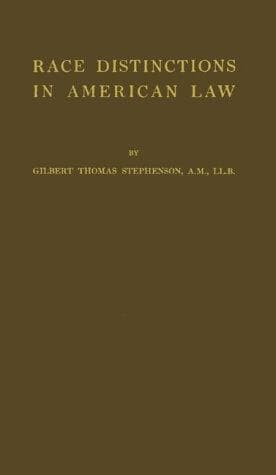
Race Distinctions in American LawStephenson, Gilbert Thomas
History
Race Distinctions in American Law
Stephenson, Gilbert Thomas
African Americans -- Politics and government; Law -- United States -- History; United States -- Race relations
The educational clause of the proposed Maryland suffrage amendment,
recently defeated at the polls by the voters of that State, restricted
the right to vote to a “person who, in the presence of the officers of
registration, shall, in his own handwriting, with pen and ink, without
any aid, suggestion, or memorandum whatever addressed to him by any of
the officers of registration, make application to register correctly,
stating in such application his name, age, date, and place of birth;
residence and occupation at the time and for the two years next
preceding; the name or names of his employer or employers, if any, at
the time and for the two years next preceding; and whether he has
previously voted, and, if so, the State, county, city, and district, or
precinct in which he voted last. Also the name in full of the President
of the United States, of one of the Justices of the Supreme Court of the
United States, of the Governor of Maryland, of one of the Judges of the
Court of Appeals of Maryland, and of the Mayor of Baltimore City, if the
applicant resides in Baltimore City, or of one of the County
Commissioners of the County in which the applicant resides.” It is easy
to see how race discriminations could have been made under this proposed
amendment, but it need not be discussed inasmuch as it failed to become
law.
“_Grandfather Clauses_”
The “Grandfather Clauses” are, in a real sense, peculiar to the Southern
States, though there are a few somewhat similar provisions in other
States. For instance, Illinois, by its Constitution of 1870, allowed
those to vote who had the right to vote on April 1, 1848, provided, of
course, they satisfied the age, sex, and residence qualifications. When
Maine added its educational requirement in 1893, it provided that this
qualification should not apply to anyone who had the right to vote in
January, 1893, or to anyone sixty years of age at that time.
Massachusetts had made a similar provision in 1857. The Constitution of
Wyoming of 1889 had said that nothing in it, except the provisions about
idiots, lunatics, and convicts, should be construed to deprive any one
of the right to vote who had that right at the time of the adoption of
the Constitution. New Hampshire does not allow paupers to vote, but it
provides that one who served in the Rebellion and was honorably
discharged shall not be disfranchised because he has received aid from
the public. In the Philippines, one unable to satisfy the educational or
property test, may, nevertheless, vote if he held a substantial office
under the Spanish régime.
Public-domain text, read in full here on John Shaqi.
Reviews
Reviews
No reviews yet
Be the first to share your thoughts on this work.
Elsewhere in the archive
Join the Discussion
Join the discussion
Sign in to leave a comment or review.
Sign InorCreate an account