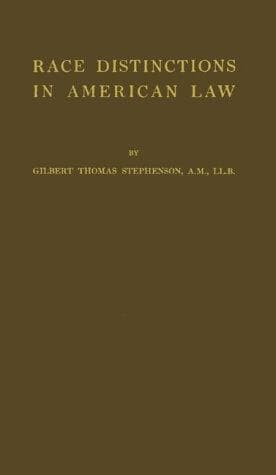
Race Distinctions in American LawStephenson, Gilbert Thomas
History
Race Distinctions in American Law
Stephenson, Gilbert Thomas
African Americans -- Politics and government; Law -- United States -- History; United States -- Race relations
All States exclude from the suffrage those who have been convicted of
certain crimes; that is, those who may have served out their terms of
imprisonment, but who have not been restored to their civil rights by
the executive department of the State. Treason and felonies like
embezzlement and bribery are the crimes most frequently mentioned. One
finds here a possible race distinction. The Southern States have greatly
added to the list of crimes which operate as an exclusion from the
suffrage. By the Constitution of Alabama of 1875, for instance, the
following were excluded from suffrage: Those convicted of treason,
embezzlement of public funds, malfeasance in office, larceny, bribery,
or any other crime punishable by imprisonment in the penitentiary. The
last Constitution of Alabama is more specific; it mentions the following
crimes as having the effect of excluding from the suffrage those
convicted of them: Treason, murder, arson, embezzlement, malfeasance in
office, larceny, receiving stolen property, obtaining property or money
under false pretenses, perjury, subornation of perjury, robbery, assault
with intent to rob, burglary, forgery, bribery, assault and battery on
wife, bigamy, living in adultery, sodomy, incest, rape, miscegenation,
crime against nature, or any crime punishable by imprisonment in the
penitentiary, or of any infamous crime or crimes involving moral
turpitude; also any person who shall be convicted as a vagrant or tramp,
or of selling or offering to sell his vote or the vote of another, or of
making or offering to make false return in any election by the people or
in any primary election to procure the nomination or election of any
person to any office, or of suborning any witness or registrar to secure
the registration of any person as an elector. Delaware and several other
States, on the other hand, exclude only those who have been convicted of
a felony. If, as the Supreme Court of Mississippi said, the Negro is
more given to furtive offences than to the robust crimes of the whites,
the exclusions of the Alabama law would seem to be directed toward these
offences. If more Negroes than whites are guilty of such crimes as
larceny and wife-beating, and of sexual irregularities, then the law
operates to disqualify for the suffrage more Negroes than whites.
SUFFRAGE IN INSULAR POSSESSIONS OF UNITED STATES
Public-domain text, read in full here on John Shaqi.
Reviews
Reviews
No reviews yet
Be the first to share your thoughts on this work.
Elsewhere in the archive
Join the Discussion
Join the discussion
Sign in to leave a comment or review.
Sign InorCreate an account