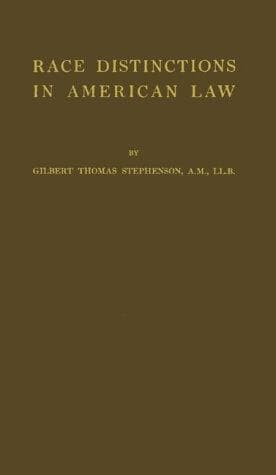
Race Distinctions in American LawStephenson, Gilbert Thomas
History
Race Distinctions in American Law
Stephenson, Gilbert Thomas
African Americans -- Politics and government; Law -- United States -- History; United States -- Race relations
It cannot be safely conjectured what the Supreme Court will say when it
squarely faces the suffrage laws of the South in their relation to the
Fifteenth Amendment. Until then, each is entitled to his opinion. That
the citizenship, age, sex, and residence qualifications are in perfect
conformity to the Amendment there is no doubt. The qualifications of tax
payment, property, and education existed long before the Fifteenth
Amendment in the States of the men most active in securing the adoption
of that Amendment. It is hardly to be supposed that the Senators and
Representatives from Massachusetts and Pennsylvania understood the
Amendment they were advocating to be nullifying the suffrage laws of
their respective States. Moreover, a property or educational test is not
an abridgment or denial of the right to vote, because it lies within the
power of everyone, regardless of race, to accumulate property and
acquire literacy.
The “Grandfather Clauses” are the most doubtful parts of the suffrage
laws. In one sense, they are not at all a denial or an abridgment of the
right to vote. Granting that the property and educational tests are
constitutional, the “Grandfather Clause,” instead of abridging or
denying, enlarges the right to vote by giving the suffrage to those who
would be disqualified under the property or educational tests. Be that
as it may, the Southern States are more uneasy about the
constitutionality of these provisions than of any others. For instance,
at the last two sessions of the legislature of North Carolina bills were
introduced to extend the “Grandfather Clause” of that State to 1812 and
1816 respectively. In each case the bill was defeated, the argument
against it being that it was unwise to open up the suffrage question
again, lest the amendment be brought into court.[727]
A leading thinker on constitutional law has given the unpublished
opinion that the “Grandfather Clauses” are in violation of the tenth
section of the first article of the Constitution of the United States,
which says that no State shall grant any title of nobility. His idea is
that an order of nobility is created whenever a class of persons is
granted exceptional political privileges, that the old soldiers and
lineal descendants constitute such a class, and that the title of
nobility is “Elector,” whether expressed or not.
Public-domain text, read in full here on John Shaqi.
Reviews
Reviews
No reviews yet
Be the first to share your thoughts on this work.
Elsewhere in the archive
Join the Discussion
Join the discussion
Sign in to leave a comment or review.
Sign InorCreate an account