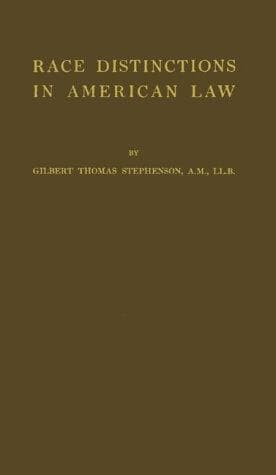
Race Distinctions in American LawStephenson, Gilbert Thomas
History
Race Distinctions in American Law
Stephenson, Gilbert Thomas
African Americans -- Politics and government; Law -- United States -- History; United States -- Race relations
Race distinctions do not appear to be decreasing. On the contrary,
distinctions heretofore existing only in custom tend to crystallize into
law. As a matter of fact, most of the distinctions which are described
above as the “Black Laws of 1865–68” are no longer in force. No State
now carries statutes prescribing the hour when a Negro laborer must
arise, requiring his contracts to be in writing, prohibiting him from
leaving the plantation or receiving visitors without his employer’s
consent, or exacting a license fee of him before he can engage in
certain trades. These laws were vestiges of the slave system and
survived but a short time after that system had been abolished.
Likewise, those statutes which prohibited Negroes from testifying in
court against white persons were repealed during the first few years
after Emancipation. But distinctions which are not the direct results of
slavery have found an increasing recognition in the law. Thus, though
Florida, Mississippi, and Texas had separate railroad coaches for
freedmen in 1866, the regular “Jim Crow” laws did not begin to creep
into the statutes of the Southern States till 1881. Now every Southern
State, except Missouri, has a law separating the races in railroad cars.
Mississippi, in 1888, was the first State to require separate
waiting-rooms. Louisiana, in 1902, took the lead in compelling separate
street car accommodations, being followed by most of the Southern States
within the last seven years.
A similar tendency toward crystallization of race distinctions into law
is found in schools. Though Massachusetts permitted separate schools as
early as 1800, and though the Southern States required them from the
beginning of their public school system, it is only recently that any
States have seen fit to create distinctions in private schools by
legislation. At present, Florida, Kentucky, Oklahoma, and Tennessee
prohibit the teaching of white and Negro students in the same private
schools, and their action in so doing the Supreme Court of the United
States in the Berea College case has decided to be constitutional.
Moreover, the Japanese school question of the West has become of
national concern only within the last two years.
In the matter of suffrage also one observes the same general trend of
practices slowly passing into statutes. Between 1877 and 1890 Negroes in
the South were disfranchised to a great extent in defiance of law.
Beginning with Mississippi in 1890 and ending with Georgia in 1908,
seven Southern States have made constitutional provisions which, though
not in letter creating race distinctions, lend themselves to race
discriminations.
Public-domain text, read in full here on John Shaqi.
Reviews
Reviews
No reviews yet
Be the first to share your thoughts on this work.
Elsewhere in the archive
Join the Discussion
Join the discussion
Sign in to leave a comment or review.
Sign InorCreate an account