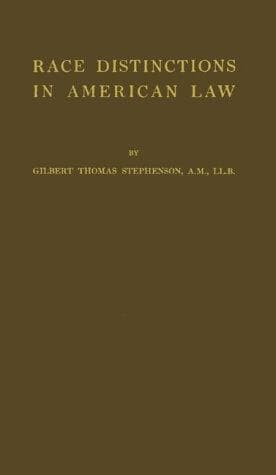
Race Distinctions in American LawStephenson, Gilbert Thomas
History
Race Distinctions in American Law
Stephenson, Gilbert Thomas
African Americans -- Politics and government; Law -- United States -- History; United States -- Race relations
Distinctions, race, defined, 1;
contrasted with race discriminations, 2–4, 348–362;
actual and legal, contrasted, 5;
in Colonies, 7;
in hotels, 124–127;
in restaurants, 127–129;
in barber shops, 129–130;
at bootblack stands, 130–131;
in billiard rooms, 131–132;
at soda fountains, 133–134;
in saloons, 132–133;
in theatres, 134–136;
at skating rinks, 136;
in cemeteries, 136–137;
by insurance companies, 138–140;
in churches, 141;
in punishments, 273–277;
in vagrancy laws, 275;
not confined to one section, 348–350;
not confined to one race, 350–351;
not decreasing, 351–353;
not based on race superiority, 353–354;
proper place of, 356–358.
District of Columbia, intermarriages in, 93;
separate schools in, 189–190;
suffrage in, 286.
Division of public school fund between races, 194–199.
E
East Orange, N. J., separate classes for white and Negro children in
public schools of, 184–185.
East St. Louis, Ill., burning school building in, to prevent Negro
school, 180.
Eating houses. See Restaurants.
Education Association, Southern, on race problem, 356;
on
curricula for Negro schools, 360.
Educational test as qualification for voting, 301–315.
See Suffrage.
Effect given by one State to marriages between Whites and Negroes in
other States, 92–95.
Eggleston, J. D., Jr., on proportion of public school fund in Virginia
contributed by Negroes, 195.
Elements, race, in United States, 6.
Eliot, Charles W., on separation of races in schools, 163–164.
Emancipation Proclamation as military expedient, 8.
_Emmanuel Magazine_ on Negroes as lawyers, 240.
Employees of railroad, “Jim Crow” laws do not apply to, 222–223.
“Enforcement Act” of 1870, 290–291.
Episcopal Church, separation of races in, 143–144.
Equality of accommodations in public schools, 192–194;
in public conveyances, 223–224.
See Schools, Conveyances, “Jim Crow” laws.
Evidence admitted as presumption of race, 17.
Exemptions from application of “Jim Crow” laws, 222, 232.
Extent of separation of races on railroad cars, 216;
on
street cars, 228–229;
of actual disfranchisement of Negroes, 320–321.
See “Jim Crow” laws, Suffrage.
Extra cars, “Jim Crow” laws do not apply to, 221.
F
Federal legislation on slave marriages, 75;
on civil rights of Negroes, 103–111;
on separate schools, 189–190.
Fifteenth Amendment, ratified, 10;
and Negro suffrage, 281–282;
and Oregon, 289;
and Maryland, 317–320.
See Suffrage.
Firearms, sale of, to Negroes prohibited, 43–44;
in Florida, 43;
keeping of, by Negroes in Mississippi prohibited, 44;
keeping of, by Negroes in South Carolina limited, 44;
selling of, to Indians in Oregon prohibited, 45;
carrying of, limited to Whites in Oregon, 45;
selling of, to Indians prohibited in Arizona, 45.
Public-domain text, read in full here on John Shaqi.
Reviews
Reviews
No reviews yet
Be the first to share your thoughts on this work.
Elsewhere in the archive
Join the Discussion
Join the discussion
Sign in to leave a comment or review.
Sign InorCreate an account