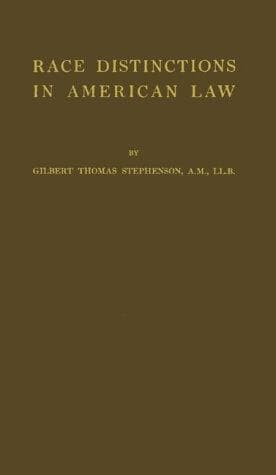
Race Distinctions in American LawStephenson, Gilbert Thomas
History
Race Distinctions in American Law
Stephenson, Gilbert Thomas
African Americans -- Politics and government; Law -- United States -- History; United States -- Race relations
“The General Assembly of North Carolina do resolve, That, while we
regard with repugnance the absurd attempts, by means of ‘Civil Rights’
Bills, to eradicate certain race distinctions, implanted by nature and
sustained by the habits of forty centuries; and while we are sure that
good government demands for both races alike that the great
representation and executive offices of the country should be
administered by men of the highest intelligence and best experience in
public affairs, we do, nevertheless, heartily accord alike to every
citizen, without distinction of race or color, equality before the law.
“_Resolved_, That we recognize the full purport and intent of that
amendment to the Constitution of the United States which confers the
right of suffrage and citizenship upon the people of color, and that
part of the Constitution of North Carolina conferring educational
privileges upon both races: that we are disposed and determined to carry
out in good faith these as all other constitutional provisions.”
STATE LEGISLATION AFTER 1883
_In South_
The civil rights legislation in the South after 1883 may be shortly
disposed of, for an examination of the session laws of the Southern
States since that time reveals only one statute that can at all properly
be called a Civil Rights Bill. That was a statute of Tennessee[243] of
March 25, 1885, providing against discrimination in theatres, shows,
parks, places of public resort for observation of scenery or amusement
of any kind whatever, where fee or toll is charged. But it adds this
significant section: “That nothing herein contained shall be construed
as interfering with the existing rights to provide separate
accommodations and seats for colored and white persons at such places.”
It may be taken for granted that the Civil Rights Bills passed in the
South by the Reconstruction administrations became inoperative, if they
were not actually repealed, as soon as the government reverted to the
hands of the resident white people. Of course, all the Southern
legislation as to separate schools and separate accommodations in public
conveyances relates to the civil rights of Negroes, and most of this has
come since 1883, but the discussion of these two important subjects is
postponed to later chapters.
_In States Outside of South_
Public-domain text, read in full here on John Shaqi.
Reviews
Reviews
No reviews yet
Be the first to share your thoughts on this work.
Elsewhere in the archive
Join the Discussion
Join the discussion
Sign in to leave a comment or review.
Sign InorCreate an account