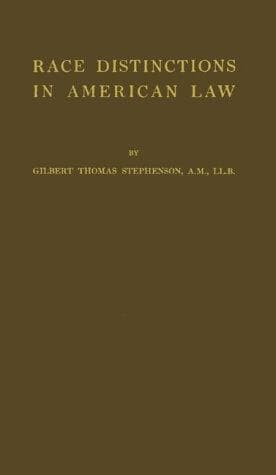
Race Distinctions in American LawStephenson, Gilbert Thomas
History
Race Distinctions in American Law
Stephenson, Gilbert Thomas
African Americans -- Politics and government; Law -- United States -- History; United States -- Race relations
The wording of all the statutes is essentially the same. Each provides
that all citizens within the jurisdiction of the State, without regard
to race, color, or previous condition of servitude, are entitled to the
full and equal accommodations, advantages, facilities, and privileges of
the various places mentioned. The offending party may be either indicted
and fined or imprisoned, or he may be sued by the aggrieved party. In
some States, an action by the State is a bar to an action by the party
and vice versa. One who aids or abets in a discrimination against a
person on account of race, color, or previous condition of servitude is
punished to the same extent as the one actually committing the act.
Heretofore only legislative enactments, State and Federal, as to the
civil rights of Negroes have been considered. It is well now to turn to
the courts to see how the laws have been interpreted as regards various
public places.
HOTELS
Only six States expressly forbid race distinctions in hotels. But it may
be assumed that the sixteen States which mention inns mean to include
hotels.
In 1876 a Negro minister applied for a room at a Philadelphia hotel and
was refused accommodation, though one of the guests offered to share his
room with him. At that time there was no law in Pennsylvania requiring
hotel-keepers to receive colored persons; but the Federal court[262]
held that the clerk might be liable under the Federal Civil Rights Bill
of 1875.
In 1898 one Russ applied for a license to open a hotel in Pennsylvania.
In granting it, the court[263] took the occasion to express its view on
race distinctions in the following words: “A sober, respectable, and
well-behaved colored man or woman is entitled under the law of
Pennsylvania to be received in any house of entertainment and be treated
in the same manner as any other guest. It is time that race
discrimination ceased in this State.... No one objects any longer to his
[the Negro’s] presence in a public conveyance or place of entertainment;
thus far the prejudice of race has been overcome; it is quite certain
that the objection to his presence in a hotel or restaurant will also
pass away as soon as his right under the law to be there is recognized
in fact as it now is by the letter of the statute.... It would be vain
to deny that some race prejudice still exists among us, but the law does
not countenance it, and good citizens should strive to rise above it. We
trust the effort will be made and that toleration and moderation will
mark the conduct of both races.”
Public-domain text, read in full here on John Shaqi.
Reviews
Reviews
No reviews yet
Be the first to share your thoughts on this work.
Elsewhere in the archive
Join the Discussion
Join the discussion
Sign in to leave a comment or review.
Sign InorCreate an account