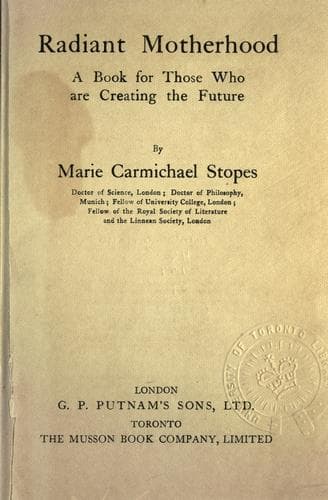
Radiant Motherhood: A Book for Those Who are Creating the FutureStopes, Marie Carmichael
Science
Radiant Motherhood: A Book for Those Who are Creating the Future
Stopes, Marie Carmichael
Mothers
Not only throughout the lower creatures do we find the responsibilities
of parenthood increasing as we go up the scale towards the higher, but,
even in the various grades of highly civilized man, the responsibility
for the children is ever greater in proportion with the general culture
and position of the parents.
Not many years ago the labourer’s child could be set to work early and
could very shortly earn his keep; while at the same time the young
gentleman was an expense and care to his father and mother until he
had passed through the University of Oxford or Cambridge, and amongst
some even until he had made his “finishing” world tour. The trend of
legislation has continuously extended the age of irresponsible youth in
the lower and lower middle classes, until it now approaches that of the
middle and upper class youth. A stride in this direction was taken by
the last Education Act, which has made education compulsory throughout
the whole country to an age which is nearly university age.
I need not labour the resulting effect of the ever increasing
prolongation of youth. It is not only apparent but has received
sufficient treatment from the hands of various authors and thinkers.
Its corollary, however, has still not received that clear and direct
thought which its significance demands. Parenthood under the present
_régime_, is not only an increasing responsibility and expense, it
has become so great a strain upon the resources of those who have for
themselves and their children a high standard of living that it is
tending to become a rare privilege for some who would otherwise gladly
propagate large families.
As Dean Inge reminded us (_Outspoken Essays_, 1919), there was a stage
in the high civilization of Greece when slaves were only allowed to
rear a child as a reward for their good behaviour. I find a curious
parallel to this in the treatment of a section of our society by our
present community.
Public-domain text, read in full here on John Shaqi.
Reviews
Reviews
No reviews yet
Be the first to share your thoughts on this work.
Elsewhere in the archive
Join the Discussion
Join the discussion
Sign in to leave a comment or review.
Sign InorCreate an account