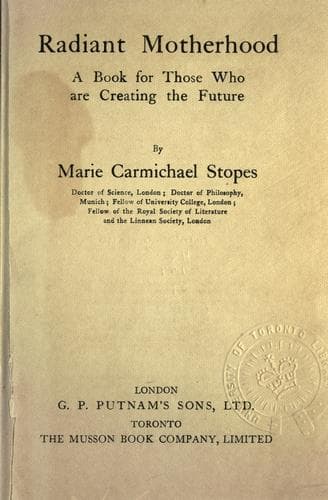
Radiant Motherhood: A Book for Those Who are Creating the FutureStopes, Marie Carmichael
Science
Radiant Motherhood: A Book for Those Who are Creating the Future
Stopes, Marie Carmichael
Mothers
There is generally an increase in the size of the breast, followed
as the months progress by a very noticeable increase in the size and
bright blue colour of the veins round the breast, and also a darkening
in colour and a changing from pink to brownish tint of the area round
the centre of the breast.
After the third month, there is visible a steadily increasing
enlargement of the lower part of the body, but, as this also happens
with some forms of illness, this alone and without the other signs is
not proof that motherhood has commenced.
“Quickening” or the movements of the child, are a much better
indication of motherhood, and these are generally to be perceived about
the twentieth week, or roughly half-way through the whole period of
prenatal life; but see further the remarks in Chapter XIII, p. 113.
The perception of the child’s heart beats is absolute proof of coming
motherhood. These may be perceived after the fourth or fifth month
quite readily by a nurse or other observer, though the mother herself
can but seldom perceive them.
“Morning Sickness,” which is so often experienced, and in most books
for the “expectant mother” is quoted as one of the first signs of
pregnancy, _should never occur at all_--see Chapter XI--although
unfortunately it is true that it does frequently occur in women who are
bearing children under present conditions.
APPENDIX B
ON BIRTH
The usual agonies of child birth vary greatly in extent according
to the structure of the woman. But, as was shown in Chapter II, the
tendency already is present, and probably will increase, for this to
be an almost intolerable strain upon the woman. Tardily indeed have
efforts to relieve her agonies in child birth been made; Queen Victoria
took a grave and adventurous step when she bore one of her children
under chloroform. Chloroform, however, only deadens consciousness at a
comparatively late stage in child birth, and its use through the many
long hours, even perhaps sometimes days of agony which precede the
later stages is not often possible. It is, therefore, for some types of
women a very insufficient narcotic.
Natural “painless Child Birth” is, of course, the ideal, and is claimed
to be the result of the “fruit and rice diet,” see _Tokology_ by Dr.
Alice Stockham, but although this greatly reduces the pain for many,
and undoubtedly makes the months of pregnancy easier, it cannot make
birth anything but a torture if the proportion of the child’s head to
the bony arch is above a given limit. The “Christian Science” claim
for not only painless but bloodless birth has been reported to me, but
never at first hand, and I have not yet had the first-hand statements
of women who are said to have experienced it.
Public-domain text, read in full here on John Shaqi.
Reviews
Reviews
No reviews yet
Be the first to share your thoughts on this work.
Elsewhere in the archive
Join the Discussion
Join the discussion
Sign in to leave a comment or review.
Sign InorCreate an account