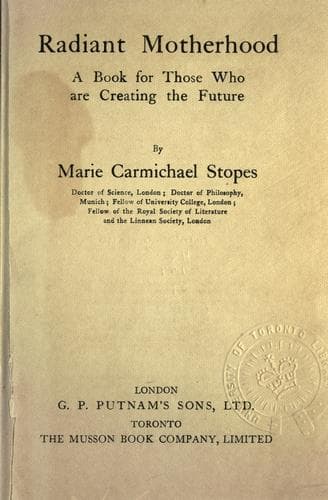
Radiant Motherhood: A Book for Those Who are Creating the FutureStopes, Marie Carmichael
Science
Radiant Motherhood: A Book for Those Who are Creating the Future
Stopes, Marie Carmichael
Mothers
Yet all the wisest mothers whom I know vary only in the degree
of their belief in this power of the mother. All are agreed in
believing that the spiritual and mental condition and environment
of the mother does profoundly affect the character and spiritual
powers of the child.
Alfred Russel Wallace, the great naturalist and co-discoverer with
Darwin of the principle of Evolution, was in many respects a pioneer
of unusual foresight and penetrating observation, who thought that
the transmission of mental influence from the mother to the child was
neither impossible nor even very improbable. In 1893 he published a
long letter detailing cases, which he prefaced by saying:--
The popular belief that prenatal influences on the mother affect
the offspring physically, producing moles and other birth-marks,
and even malformations of a more or less serious character, is
said to be entirely unsupported by any trustworthy facts, and it
is also rejected by physiologists on theoretical grounds. But I
am not aware that the question of purely mental effects arising
from prenatal mental influences on the mother has been separately
studied. Our ignorance of the causes, or at least of the whole
series of causes, that determine individual character is so great,
that such transmission of mental influences will hardly be held to
be impossible or even very improbable. It is one of those questions
on which our minds should remain open, and on which we should be
ready to receive and discuss whatever evidence is available; and
should a _primâ facie_ case be made out, seek for confirmation
by some form of experiment or observation, which is perhaps less
difficult than at first sight it may appear to be.
In one of the works of George or Andrew Combe, I remember a
reference to a case in which the character of a child appeared to
have been modified by the prenatal reading of its mother, and the
author, if I mistake not, accepted the result as probable, if not
demonstrated. I think, therefore, that it will be advisable to make
public some interesting cases of such modification of character
which have been sent me by an Australian lady in consequence
of reading my recent articles on the question whether acquired
characters are inherited. The value of these cases depends on their
differential character. Two mothers state that in each of their
children (three in one case and four in the other) the character
of the child very distinctly indicated the prenatal occupations
and mental interests of the mother, though at the time they were
manifested in the child they had ceased to occupy the parent, so
that the result cannot be explained by imitation. The second mother
referred to by my correspondent only gives cases observed in other
families which do not go beyond ordinary heredity.
Public-domain text, read in full here on John Shaqi.
Reviews
Reviews
No reviews yet
Be the first to share your thoughts on this work.
Elsewhere in the archive
Join the Discussion
Join the discussion
Sign in to leave a comment or review.
Sign InorCreate an account