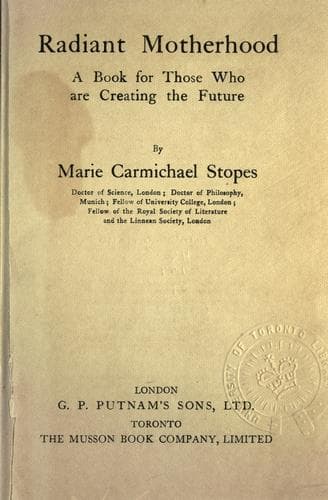
Radiant Motherhood: A Book for Those Who are Creating the FutureStopes, Marie Carmichael
Science
Radiant Motherhood: A Book for Those Who are Creating the Future
Stopes, Marie Carmichael
Mothers
The advice to marry young, which is in every respect socially wise and
physiologically correct for some, should not be hurled indiscriminately
at all women, because for the late maturing such advice is socially
disadvantageous and physiologically wrong.
I am now ready to consider the question of the proper age for
motherhood about which an immense variety of opinion is expressed. The
general tendency has been, even in the last few years, to raise the
age at which a girl may marry, and to raise the age which the medical
profession advises as the earliest suitable for motherhood. But still
one often hears of elders, whom one would in other respects like to
follow, advising the early bearing of children.
Now I should like every potential parent to consider what type of child
they want. Do they want to secure healthy, jolly little animals with no
more brains than are sufficient to see them creditably through life? If
so, let them have their children very early. Such healthy sound people
with no special gifts are valuable, and there is much work in the world
for them to do. On the other hand, do they want to take the risk for
their child of a possibly less robust body, but with the possibility,
indeed, in healthy families, almost the certainty, of an immensely
greater brain power, and a more strongly developed temperament? Then
let them have their children late. And if a man desires to have a child
who may become one of the _master_ minds whose discoveries, whose
artistic creations, whose ruling power stamps itself upon the memory
of our race, whose name is handed down the ages, then let the father
who desires such a child mate himself with the long-young late-maturing
type of woman I have just described, and let her bear that child some
time between the age of thirty-five and forty-five.
How often one hears some version of the phrase: “Yes, it is so sad,
poor, dear Lord So-and-So, a charming man, but no brains at all; his
younger brother such a brilliant man; but that is always the way, the
eldest sons in the aristocracy do seem to get the gift of property
balanced by the lack of brains.” Now I enquire, and I should like my
readers to enquire, into the secret of this phenomenon, which is by
no means universal, but is sufficiently common to be endorsed. In my
opinion, the interpretation of this fact is that the earlier children
were born when the mother was still too young to endow them with
brains, particularly if the mother was one of the gifted and cultivated
women of the late-maturing type.
Public-domain text, read in full here on John Shaqi.
Reviews
Reviews
No reviews yet
Be the first to share your thoughts on this work.
Elsewhere in the archive
Join the Discussion
Join the discussion
Sign in to leave a comment or review.
Sign InorCreate an account