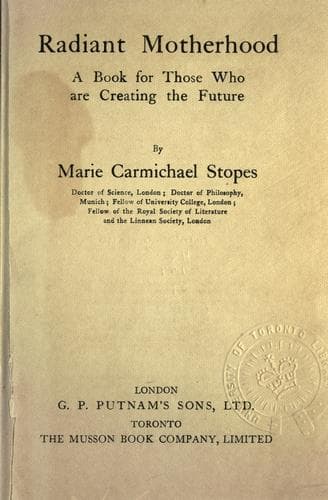
Radiant Motherhood: A Book for Those Who are Creating the FutureStopes, Marie Carmichael
Science
Radiant Motherhood: A Book for Those Who are Creating the Future
Stopes, Marie Carmichael
Mothers
out of place, which some years afterwards may acutely handicap the
unfortunate woman.
In the name of all the fond and happy mothers that I hope the future
may contain, I would urge every one who possibly can to _insist_ on
having six weeks of “lying in.” This is not only in the interests of
general health but of beauty. Too long have we become tolerant of the
hideous formation of the body which is common in older women. We have
domesticated some animals[8] solely for our own purposes, and they are
hideous indeed. Why should we women permit a comparable standard for
ourselves? Why not insist on at least as much care as is devoted to the
race-horse? Why not take a period of rest after the great effort of
maternity proportionately as long as a she-wolf or tigress takes in her
cave, fed by her mate while she lies about and plays with her cubs?[9]
The standard of beauty of the racing mare, of the wild tigress or
she-wolf is slender and not markedly different from that of its virgin
state. Such a standard, and not that of the over-taxed, man-used,
domesticated animals should be that on which we women should insist.
[8] The sow normally breeding once a year, artificially forced to breed
two or three times a year. Its appearance is proverbial.
[9] This has been reported to me by travellers and others, but I cannot
get an authoritative scientific record for the fact.
In this connection should be mentioned one other way in which the
following of Nature and obedience to her law works for good. In the
next chapter I mention the baby’s right to be fed by nature’s food, and
while the infant is nursing from its mother it stimulates contractions
in the womb which very much assist in bringing it to its right size and
position, and so the act of nursing benefits not only the infant but
its mother.
A number of researches by various experts have been made, which proves
that the womb reacts to the stimulus of suckling by the child. Pfister
(_Beit. z. Geb. u. Gyn._, 1901, vol. v, p. 421), for instance, found
that very definite contractions took place during the baby’s suckling,
particularly for the first eight days after its birth; also Temesváry
(_Journ. Obstet. and Gyn. Brit. Emp._, 1903, vol. iii, p. 511) found
that the natural involution of the womb after birth was distinctly more
rapid in those who nursed their babies than in those who did not.
Prolonging the nursing period does undoubtedly not tend to increase
the beauty of the woman’s bosom but to deteriorate it, but, for at any
rate the first few months, it is _very_ advantageous both to the mother
and to the child that she should feed it naturally. If throughout the
nursing period she slings her breast properly from above, and if when
the nursing period ceases she massages and treats the breast properly,
it should not lose its beauty in the way which is alas, to-day, too
general.
Public-domain text, read in full here on John Shaqi.
Reviews
Reviews
No reviews yet
Be the first to share your thoughts on this work.
Elsewhere in the archive
Join the Discussion
Join the discussion
Sign in to leave a comment or review.
Sign InorCreate an account