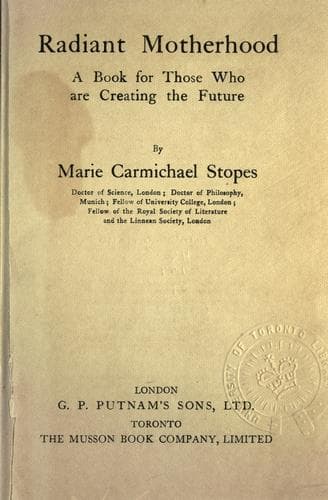
Radiant Motherhood: A Book for Those Who are Creating the FutureStopes, Marie Carmichael
Science
Radiant Motherhood: A Book for Those Who are Creating the Future
Stopes, Marie Carmichael
Mothers
When your little son or daughter is about the age of three or four
or five, the day will come when you are asked questions about the
most fundamental facts in human life, and then the answers to these
questions contain the probability of a lifelong memory. Answer with the
_truth_.
Many parents are anxious to tell their children the great truths in
a wise and beautiful manner. But few feel that they know how to do
it, for it is a most difficult thing to know how to answer searching
questions about profound subjects, and particularly about those which
the community wrongly considers shameful. Each mother knows, or should
know, the temperament and needs of her child, so that the adaptation
of the advice I give should be varied to suit the individual child. In
essence, however, children’s demands at an early age are remarkably
similar, and the questions of children on birth and sex differ in form,
though seldom in substance.
The following conversation between a mother and her little son
indicates what seems to me the best way first to tell a child who has
reached the age when he may have lasting memory of the facts that he is
blindly seeking in his baby questions. It will not suffice to learn the
answers off by heart; the baby will then soon confound his elders, but
the substance of the conversation should prove useful.
The very first time the query comes: “Mother where did you get me?” the
mother must not divert the child’s interest, or hesitate, but should be
ready at once to answer:--
“God and Daddy and I together made you, because we wanted you.[11]”
[11] At the request of many readers this conversation was published
in the _Sunday Chronicle_.
“Did God help? Couldn’t He do it all Himself?”
“You know when you and I are playing with bricks together, you like
Mummy to help, but not to do it all. God thought Daddy and Mummy
would like Him to help, but not to do everything, because Daddy
and Mummy enjoyed making you much more than you enjoy playing with
bricks.”
That may suffice for the time, because little children are very readily
satisfied with one or two facts about any one subject, and the talk
could easily be diverted. The little mind may brood over what was told,
and some time later--perhaps a few days, perhaps even a few months or
more--this question will come up again, possibly in a different form:--
“Mummy, when was I born?”
The mother should give the day and say:--
“You know your birthday comes every year on the 18th of April. That
birthday is what reminds us of the day you were born, and each
birthday you are a whole year older.”
“I’m five now.”
“Yes, so you were born five years ago on your birthday.”
“Where was I before I was born?”
“Don’t you remember I told you that God and Daddy and I made you?”
“Yes.... Did you make me on my birthday?”
“Not all in one day; you took much longer to make than that.”
“How long did I take to make?”
Public-domain text, read in full here on John Shaqi.
Reviews
Reviews
No reviews yet
Be the first to share your thoughts on this work.
Elsewhere in the archive
Join the Discussion
Join the discussion
Sign in to leave a comment or review.
Sign InorCreate an account