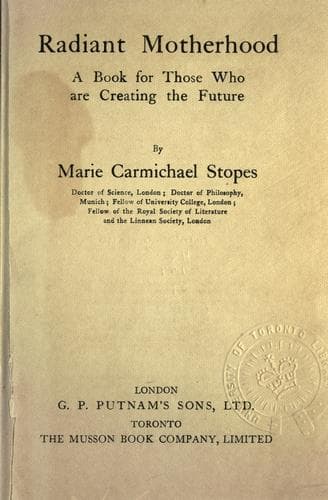
Radiant Motherhood: A Book for Those Who are Creating the FutureStopes, Marie Carmichael
Science
Radiant Motherhood: A Book for Those Who are Creating the Future
Stopes, Marie Carmichael
Mothers
The incredulous may answer this question by asserting that they don’t,
but as a matter of fact they do. The Registrar-General’s Report for
1911 shows that of every thousand births in the upper and middle
classes, 76·4 babies die, while of a thousand births in the homes of
unskilled workmen (this would be the class of the “poor” mothers) 152·5
babies die.
So that it is clear that if each member of this poorest class of
mothers had exactly the same number of babies as each mother of the
rich class, she would have to purchase about two coffins for every
coffin bought by those whose babies are not so prone to die.
There is, however, another fact which completes the proof of my first
sentence. The upper and middle classes do not have so many children per
family as do the poorest class. To a thousand married people in the
upper and middle classes there were born in 1911 119 babies, but to
the poor mothers--the wives of the unskilled workmen--there were born
213. So that in addition to buying twice as many coffins per thousand
children born, these poor mothers have nearly twice as many coffins
again, owing to the fact that nearly twice as many children are born to
them.
I wonder if poor women have ever asked themselves if they can afford
coffins at this rate?
Of course the coffins of these poor little babies are very small, and
do not require very much wood to make them. But let us think in what
other ways they cost: To the mother they cost not only all the little
the baby had eaten, and used in the way of clothes before its death,
but all the wastage of her own vitality while she was bearing it; she
could not work so well, at any rate towards the end of the time.
Home duties had to be somewhat neglected; the older children had to
go to school dirtier and less cared for; the husband had less comfort
and fewer smiles; every one in the family was poorer, not only in
material things and in the work that might make material things, but in
happiness and buoyancy.
It needs no imagination to realize, when you have once grasped these
facts, that poor people are much less able to spare the cost of a
doomed baby than are the better class people. Then why do they so often
indulge in this tragic luxury? Chiefly through lack of knowledge,
through ignorance, particularly on the part of the mother.
Often ignorance is blind and unaware that it is ignorance, stupidly
blundering through life; but this is not always the mother’s attitude.
She may, indeed she often does, passionately desire knowledge and seek
for it wherever she thinks she may find it in her restricted circle.
Too tragically often she is baffled in her search.
Some years before the war, when I was lecturing at a Northern
University, a little incident opened my eyes to this fact. I was young
and had not encountered this aspect of life before, and it burnt itself
into my consciousness as one of the most vivid impressions of my life.
It was this:--
Public-domain text, read in full here on John Shaqi.
Reviews
Reviews
No reviews yet
Be the first to share your thoughts on this work.
Elsewhere in the archive
Join the Discussion
Join the discussion
Sign in to leave a comment or review.
Sign InorCreate an account