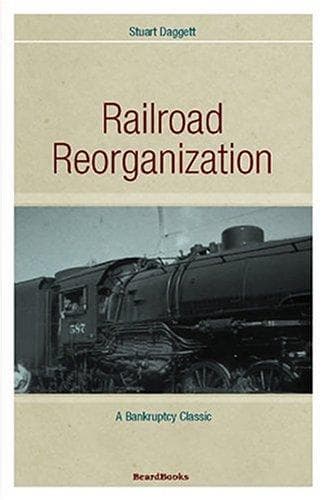
Railroads -- United States; Railroads -- United States -- Finance
Aside from the question of the government debt there seemed to be a
general agreement as to what was needed to be done. Every suggestion
contemplated the payment of the first mortgage in full and the
reduction of the interest upon the junior securities; most included
with this an assessment on the stock, and one at least proposed the
cancellation of the guarantee on the stock of the Oregon Railway &
Navigation Company.[512] The principles were obvious. A large sum of
money had to be raised with which to pay the floating debt and to meet
possible demands by the Government. This had to come from the junior
securities or from the stock, and preferably from the stock, which
represented ownership in the enterprise. On the other hand, reductions
in fixed charges had to come from the junior securities as the youngest
interests which had a mortgage lien. Differences of opinion occurred
upon the details. Should there or should there not be a foreclosure?
How large an assessment was required? How great must the reduction in
interest charges be, and should bonds or stock or both be given to the
junior securities in exchange for their holdings? Should the system as
it stood be preserved, or should certain parts of it be let go?
In June, 1894, Mr. Boissevain stated that the reorganization committee
thought that they should be in a position to formulate a complete
plan of reorganization speedily after the terms of the adjustment of
the debt to the United States had been approved by Congress. “It is
our opinion that the fixed charges of the reorganized company ...
should not exceed $8,500,000 per annum. Certain classes of existing
bonds secured by mortgage on portions of the system cannot be and
should not be disturbed, as they are amply secured by property earning
the interest which is payable thereon. Other bonds, however, must be
converted in whole or in part into securities not imposing a fixed
charge upon the reorganized company. While the reorganization committee
has not approved of any definite plan, we believe that holders of bonds
which must be disturbed and creditors and stockholders interested in
the system can be provided for upon an equitable basis by the creation
of the following securities:
(_a_) An issue of general mortgage bonds (at 4 per cent), secured by a
general mortgage covering the entire system, subject to such mortgages
as cannot be disturbed, and to the lien of the United States upon the
main line and Kansas Pacific division for the adjusted debt.
(_b_) An issue of 5 per cent preferred stock.
(_c_) An issue of common stock.
The plan of reorganization would require provision to be made to
take up the trust notes secured by valuable collaterals. The funds
required for this purpose and for the other cash requirements of the
reorganization would be met in part by a reasonable assessment upon the
stockholders, and in part by the sale of new securities.”[513]
Public-domain text, read in full here on John Shaqi.
Reviews
Reviews
No reviews yet
Be the first to share your thoughts on this work.
Elsewhere in the archive
Join the Discussion
Join the discussion
Sign in to leave a comment or review.
Sign InorCreate an account