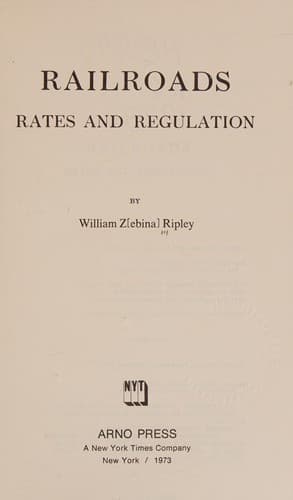
Railroads: Rates and RegulationsRipley, William Zebina
History
Railroads: Rates and Regulations
Ripley, William Zebina
Railroads -- Freight -- Rates -- United States; Railroads and state -- United States
for coal, lime, or cement, but does not affect the rates chargeable on
high-class freight which seldom goes by water in any event. A railway
specially interested in the development of some particular industry,
wherever it crosses our hypothetical line, effectively holds down
the rate on the product of that business. Junction points with other
railways having no such interest may have no influence upon that rate,
but may cause modifications in other directions. Another railway being
in need of back loads over its line, as the result of a predominant
movement, let us say, of beef cattle at certain seasons of the year,
may introduce competition in all the tonnage capable of being carried
on cattle cars. Such a road holds down the rates on this traffic
wherever it happens to cross, but has no effect upon any other rate.
Thus it comes about in practice, as the last diagram well illustrates,
that the tariff lines cross and recross one another, generally rising
with increasing distance, but at all sorts of different times and
places.
Few generalizations are possible in this connection. Rate making
must in a growing country ever be a matter of infinite detail. It is
generally true, however, that beyond a certain point the tariff on
different grades of commodities will separate more and more widely
with increasing distance. For, obviously, after the low-grade goods
have reached the maximum which they can bear--and this they tend to do
speedily--they must remain practically constant; while those of higher
grade continue progressively rising. And for very short distances
the rate on the low-grade goods may even exceed that imposed upon
higher-class tonnage. The coal rate for a ten-mile haul may exceed that
upon some commodity worth twice as much; but for a 200-mile haul the
coal rate may be only one-eighth of the rate on the other goods. Long
experience on the part of the carriers has, however, enabled them to
arrange their tonnage in classes; for each of which the conditions are
more or less uniform. By reserving the exceptional traffic for special
treatment under commodity rates, a fairly consistent scheme of charges,
rising by stages with increasing distance may be evolved.
Public-domain text, read in full here on John Shaqi.
Reviews
Reviews
No reviews yet
Be the first to share your thoughts on this work.
Elsewhere in the archive
Join the Discussion
Join the discussion
Sign in to leave a comment or review.
Sign InorCreate an account