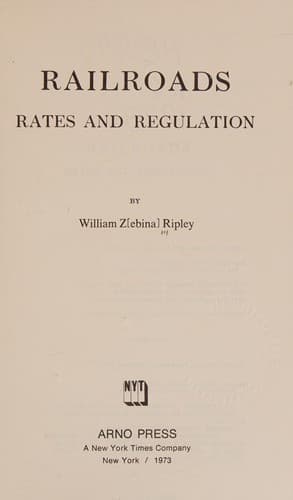
Railroads: Rates and RegulationsRipley, William Zebina
History
Railroads: Rates and Regulations
Ripley, William Zebina
Railroads -- Freight -- Rates -- United States; Railroads and state -- United States
Competition of facilities, the second of the three phases of railway
competition above mentioned, deals, as its name implies, not at
all with the rates charged but with the facilities or conveniences
afforded. Such competition is confined solely to rivalry for
business at the established rates. Immediately on the appearance
of any departure from these conditions the question becomes one
of competition of either of the other two sorts. An instance of
competition of facilities would be the introduction of reclining
chairs or of a superior service in passenger business. When the Rock
Island system offered such facilities without an extra charge, it
became necessary at once for others to meet this competition in the
same way that they would meet a reduction of rates. Any reduction in
time of transit for freight business between two given points without
extra charge, would in the same manner give rise to competition
of facilities. Such facilities, however, as might have a distinct
money value, as, for instance, free storage, cartage, demurrage or
milling-in-transit, any one of which practically amounts to giving
value without charge, are, of course, equivalent to a reduction of the
rate; and do not belong in this class of considerations at all. Only
those conveniences or facilities, which, while attempting to secure
business may not be compounded for money, should be classified in this
group. It should also be observed that competition of facilities may as
readily arise between parts of the same railway system or under pooling
agreements to maintain rates, as between distinct and independent
companies.[81] And such competition between parent and child often
arises. Thus, for instance, business was as actively solicited as ever
by the Pennsylvania and the Baltimore & Ohio in competition during the
several years of financial control of one by the other prior to 1907.
The New Haven railway may compete with its own water lines around Cape
Cod or on Long Island Sound. But in all of these instances the cardinal
feature to note is that the competition is always at the established
rate. For New England, although the New Haven system and the Boston
and Maine do not compete on rates at their points of contact, there
is constant rivalry in respect of facilities or service. The same
thing is undoubtedly true of the Atchison and the Southern Pacific
in the carriage of California fruits. Although operated under pooling
agreements, yet they were competitors in the matter of the service
offered. Each sought an enlarged volume of tonnage, but not by cutting
the agreed rate.
Public-domain text, read in full here on John Shaqi.
Reviews
Reviews
No reviews yet
Be the first to share your thoughts on this work.
Elsewhere in the archive
Join the Discussion
Join the discussion
Sign in to leave a comment or review.
Sign InorCreate an account