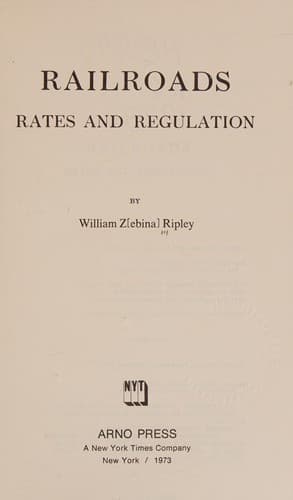
Railroads: Rates and RegulationsRipley, William Zebina
History
Railroads: Rates and Regulations
Ripley, William Zebina
Railroads -- Freight -- Rates -- United States; Railroads and state -- United States
three hundred and fifty miles from Burlington to Omaha across Iowa,
or even seven hundred miles by the roundabout line of the Illinois
Central skirting both states. In brief, every railway which touches
both rivers, however circuitous its route, is compelled to quote the
same rate from every point on the Mississippi river to every other
point on the Missouri. This rate must be the one fixed, as already
described, for the shortest direct line, namely sixty cents per hundred
pounds first class. Furthermore, in precisely the same way that these
rates to Missouri river points from the eastern seaboard are built up
and equalized, the rates from Chicago to the same Missouri river points
must be kept even. The rate through from any one of the long chain of
Mississippi gateways must be the same irrespective of distance. This
figure, by common agreement, has for many years been twenty cents per
hundred pounds higher than the rate across Illinois to the Mississippi
river gateways from Chicago alone. The dominant note of this whole
tariff is equalization of rates between all points in competition with
one another over all possible routes. Freight thus moves freely in
every direction and all markets are held on an absolute parity.[101]
It is one of the most remarkable features of American commercial
organization, this practical elimination of the element of distance
from interstate trade over wide areas.
The possible evil lurking in too widespread an acceptance of the
principle of the flat rate is clearly apparent in the reasoning of the
Eau Claire, Wisconsin, lumber case.[102] This town complained of the
disability under which it labored in shipping lumber to Missouri river
points by comparison with other places round about. It appeared in the
evidence that as early as 1884, under arbitration, all the rates from
competing centres had been adjusted on the basis of differentials;
and that, as interpreted by the carriers, the purpose of these
differentials was to even up the differences between competing towns;
to the end that all manufacturers should be put upon an equality in
the consuming territory. But this necessarily involved the practice
of penalizing or nullifying in a way the advantages of location. "If
Eau Claire could produce lumber cheaper than Winona or La Crosse, then
the latter points were to have a lower rate in order to enable them to
compete." This practice the Interstate Commerce Commission condemned at
that time; and it has consistently adhered to the precedent then laid
down. Obviously, any other general course of action would be analogous
to hobbling the fleetest horse in a race to bring him down to the rate
of progress of the slowest laggard. The principle of the handicap
applied within moderate limits makes for an exciting athletic contest;
but if it be overdone, it eliminates all interest from the contest
whatever. The race becomes one, not of skill or endurance in running,
but of securing a sufficiently liberal handicap.
Public-domain text, read in full here on John Shaqi.
Reviews
Reviews
No reviews yet
Be the first to share your thoughts on this work.
Elsewhere in the archive
Join the Discussion
Join the discussion
Sign in to leave a comment or review.
Sign InorCreate an account