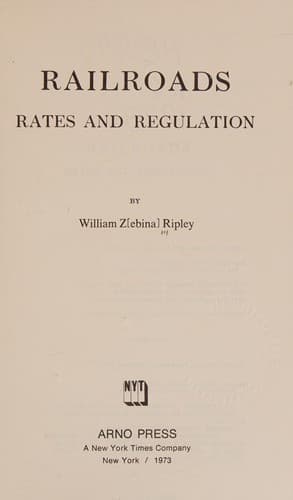
Railroads: Rates and RegulationsRipley, William Zebina
History
Railroads: Rates and Regulations
Ripley, William Zebina
Railroads -- Freight -- Rates -- United States; Railroads and state -- United States
of increasing expenses of operation, and partly upon the broader ground
that the freight rate being proportioned to the price of the product,
should rise in harmony with it. Upon this question the Commission was
divided, the majority holding in favor of annulling the increase,
while the chairman and one other member decided that the increase was
justifiable.[126]
Elasticity and quick adaptation to the exigencies of business are
peculiarities of American railway operation. Our railway managers
have always been most progressive in seeking, in and out of season,
to develop new territory and build up traffic. The strongest contrast
between Europe and the United States lies in this fact. European
railways more often take business as they find it. Our railways
_make_ it. Much of this business is made possible only by special
rates adapted to the case in hand. These need not be secret or
discriminating, as has already been observed. For although offered with
reference to particular cases, they may be open to all comers. The
economic justification lies in the fact that the railway can afford
to make a low rate, leaving a bare margin of profit above the _extra_
cost of adding this traffic to that which is already in motion. Such
rates cannot exceed a definite figure based upon what the traffic will
bear. A higher rate than this would kill the business. Something is
contributed toward fixed charges by the new traffic, so far as the
railway is concerned; and at the same time the shipper on his part
is enabled to enlarge his operations. Yet such a scale of rates if
applied to the whole traffic of the railway might be ruinous in the
extreme. The domestic shipper of wheat may conceivably be helped,
rather than injured, by a special rate on grain for Liverpool without
which the railway would lose the business entirely. To transport
California fruit for a mere fraction of the rate per ton mile which
is laid upon other traffic may actually enable those other goods to
be carried more cheaply than before. Of course, if the other traffic
be directly competitive, as for instance in this case, oranges from
Florida, that is an entirely different matter. Railway representatives
rightfully insist upon these special rates to develop new business as
a boon to the commercial world. They contrast them with the hard and
fast schedules of European railways. They allege that such elasticity
loosens the joints of competition, "keeps everyone in business,"
equalizes prices over large areas, and is in fact the life of trade.
One of the stock objections to railway regulation is that it may
lessen this elasticity, "substitute mile posts for brains," and produce
stagnation in place of activity.
Public-domain text, read in full here on John Shaqi.
Reviews
Reviews
No reviews yet
Be the first to share your thoughts on this work.
Elsewhere in the archive
Join the Discussion
Join the discussion
Sign in to leave a comment or review.
Sign InorCreate an account