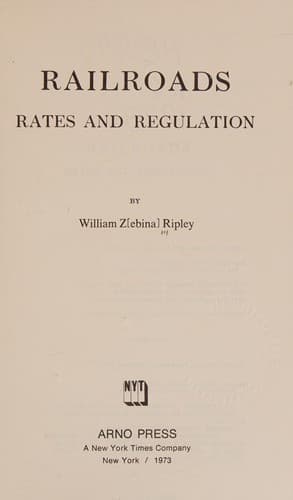
Railroads: Rates and RegulationsRipley, William Zebina
History
Railroads: Rates and Regulations
Ripley, William Zebina
Railroads -- Freight -- Rates -- United States; Railroads and state -- United States
Too many special commodity rates, intended to meet the needs of
particular shippers instead of increasing new business, may merely
bring about economic waste through exchange between widely separated
markets or by causing an invasion of fields naturally tributary to
other centres.[135] Whenever a community producing a surplus of a given
commodity supplies itself, nevertheless, with that same commodity from
a distant market, economic loss results. Numerous instances could be
cited where identical products are redistributed after a long carriage
to and from a distant point in the very area of original production.
Dried fruits may be distributed by wholesale grocers at Chicago in the
great fruit-raising regions of the West and South. Cotton goods made
by southern mills may be shipped to New York or Chicago, and then sent
back again for final distribution with the addition of a middleman's
commission and a double freight rate. The Colorado Fuel & Iron Company
seeks special rates in order to sell goods over in Pittsburg territory;
while its great competitor, the United States Steel Corporation, has
an equal ambition for the trade of the Pacific Slope. In another case
it appeared that a sash and blind manufacturer in Detroit was seeking
to extend his market in New England. Manufacturers of the same goods
in Vermont were simultaneously marketing their product in Michigan.
The Detroit producer did not complain of this invasion of his home
territory, but objected to the freight rate from Boston to Detroit,
which, probably because of back loading, was only about one-half the
rate on his own goods from Detroit to the seaboard. Is not this an
economic anomaly? Two producers, presumably of equal efficiency, are
each invading the territory naturally tributary to the other and are
enabled to do so by reason of the railway policy of "keeping everyone
in business." The New England railways are compelled by reason of the
remoteness to their territory to defend this policy. As President
Tuttle, of the Boston & Maine, expresses it, "I should be just as much
interested in the stimulating of Chicago manufacturers in sending
their products into New England to sell as I would be in sending
those from New England into Chicago to sell. It is the business of
the railways centering in Chicago to send the products from Chicago
in every direction. It is our particular business in New England to
send New England products all over the country. The more they scatter
the better it is for the railways. The railway does not discriminate
against shipments because they are east bound or west bound. We are
glad to see the same things come from Chicago into New England that
are manufactured and sent from New England into Chicago." No one
questions for a moment that the widening of the sphere of competition
by transportation agencies is a service of incalculable benefit to
the country. But it should also be borne in mind that superfluous
transportation is economic waste.
Public-domain text, read in full here on John Shaqi.
Reviews
Reviews
No reviews yet
Be the first to share your thoughts on this work.
Elsewhere in the archive
Join the Discussion
Join the discussion
Sign in to leave a comment or review.
Sign InorCreate an account